• Siena in the Rain

    Saturday, 21 ottobre 2006

    “It rarely rains in Siena…” ~ Rick Steves, Florence and Tuscany 2007

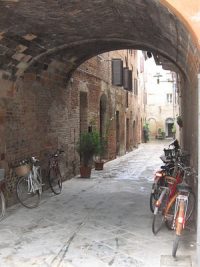
    Guess we just got lucky! I kind of enjoyed the rain. It was the good drenching kind that gardeners and ducks appreciate, and it gave me a different perspective. When we arrived at Spannocchia, I noticed that it was very dry. I’m sure that they welcomed the rain, too.

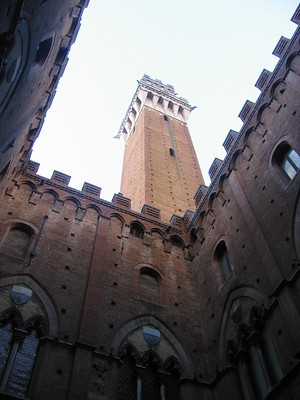
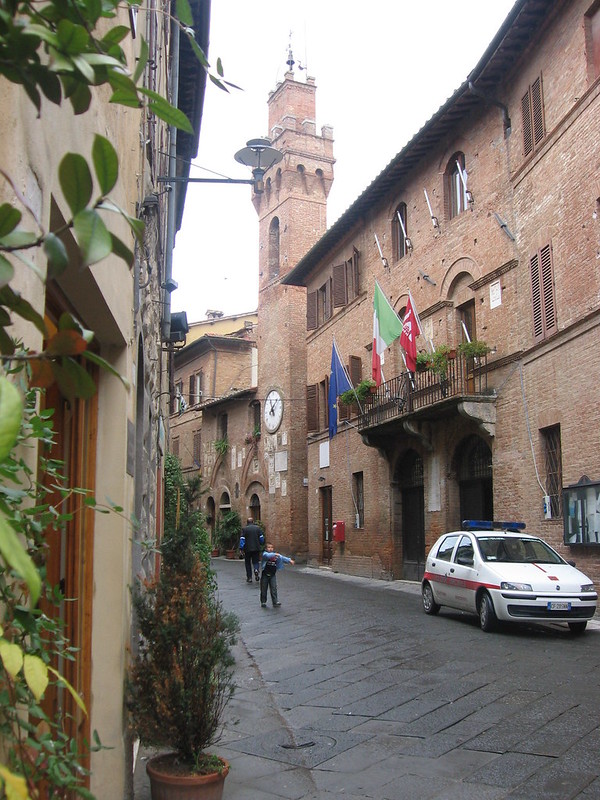
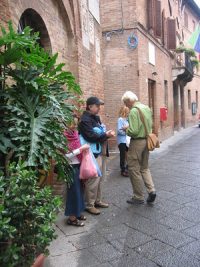
    The bus let us off at the bottom of the hill and we walked up to the famous center of Siena, Il Campo. The first thing we all did was sit down under some tents at a caffe, have some hot drinks, and make plans for splitting up and meeting later. Sandino and I opted to go to the Duomo and take advantage of “free” admission (included in our class fees). We had somehow missed going inside any churches or cathedrals in Firenze, although the outsides of those structures were quite impressive.

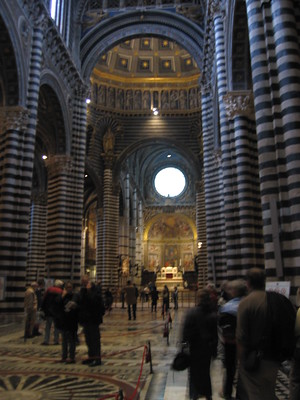
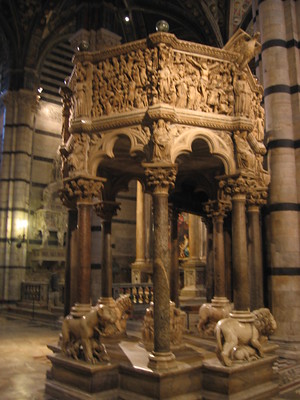
    The inside of Siena’s Duomo was magnificent. If you’ve ever tried to photograph the inside of a cathedral, you understand that it is not possible to do it right. I was able to get a bit of a sense of it without my flash. The inlaid marble mosaics on the floor probably got as much of my attention as anything (see the photo at the bottom of this post for a famous one), but this was easily the most beautiful indoor space I have ever seen.

    Sandino and I walked in and out of shops for most of the rest of the time, but we didn’t buy anything. Sandy wasn’t interested in the food shops and I wasn’t interested in much else, so we finally went back to the same caffe overlooking the Campo and had a couple of birre (beers). Carol joined us and we started swapping stories about Greensboro, and eventually others drifted in. The waitresses began bringing out free appetizers that were really good, so it was hard to restrain myself, but we were about to go eat a major meal at a restaurant. I enjoyed just kicking back with some good companions, looking out at people reappearing on the sidewalks as the rain subsided, and watching the restaurant staffs getting their places ready for the evening crowds.

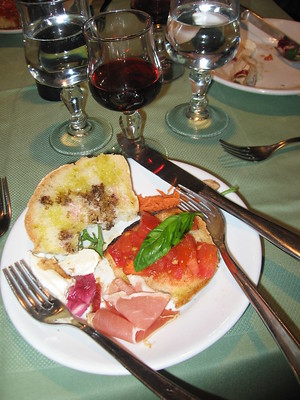
    When we got to Antica Trattoria Papei, we found that they put our group in a separate room. I’m sure that they thought that this was special, but I looked forward to a more authentic restaurant experience in the midst of the other diners. I suppose that was hard with a group of nineteen. Nevertheless, the meal was wonderful and our server was gregarious and friendly. I wish that I had jotted down notes about the meal, but I do remember that the waiter would not tell us what the meat spread on the crostini was until after we tasted it – spleen – and that the secondo was pheasant with a contorno of spinach, and that I finally tasted grappa after the meal – whew – and that I was so thoroughly stuffed that I thought that someone would have to roll me to the bus. We had several toasts and it was a little sad for me – this was our last dinner as a group in Italy.

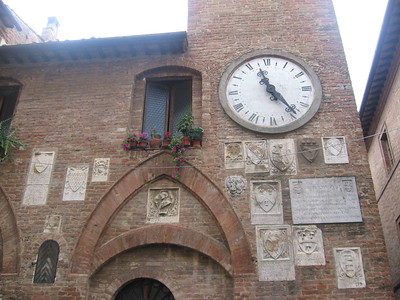
    Firenze is much more convenient to an airport, but I wish that we had spent a couple of nights in Siena. It was an interesting place, and very beautiful. When I go to Spannocchia this summer, maybe I’ll get to go back and see it in a different light and season.

    To be continued…

  • Saturday, 21 ottobre 2006

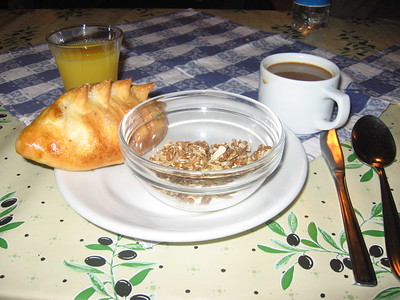
    This was our typical breakfast, except that breakfast this day featured bread baked by Stefano in the brick oven the day before. The granola is made after the last pizzas are baked in the brick oven on pizza nights, left in the warm oven overnight to bake. Here it is served over fresh plain yogurt. What’s missing in the photo that was available each day is homemade jam and preserves and hard-boiled eggs.

    I stopped by the Spannocchia gift shop (a small room that also served as the guest check-in) and bought my souvenirs from them. I purchased La Cucina di Spannochia (a self-published cookbook), an embroidered apron with the image of the “Castello di Spannocchia” on it, several laminated bookmarks with sprigs of wildflowers and herbs, honey, one bag of farro (an Italian grain similar to wheat), and two bottles of red organic Spannocchian wine.

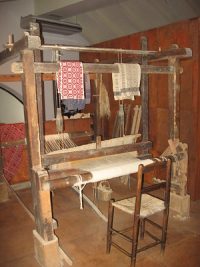
    Charlie and Debby decided to take us to a small town that was off the tourist track, and which also had a museum dedicated to the subject on which we were concentrating – the Museo della Mezzadria.

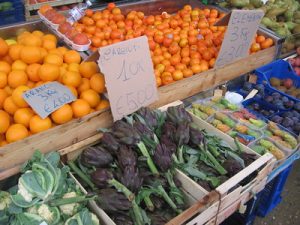
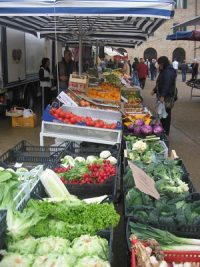
    Buonconvento had a street market on Saturday mornings which sold many different kinds of items, including produce, meats, cheeses, household goods, shoes, and clothing. This was a shopping place for the regular Italian residents, although we still ran into a few Americans. No wonder people get sick of us – we’re everywhere! Rain sprinkled off and on and the sky threatened more to come, so I bought a cheap umbrella and Sandino, who is much too manly to be caught dead with an umbrella, bought a wool cap. Along with his wool coat, his outfit performed a lot better than I expected, I’ll admit.

    I spent a few euros here on a tablecloth with a green/blue olive design (to remind me of those tablecloths in the Spannocchia dining room), a cute little woven kitchen rug (which, of course, Miss Jazz anointed within a month), and a gold wool zippered sweater whose price mysteriously increased between the time I asked about it and the actual purchase, but I let it go and didn’t argue about it. I’m a terrible shopper at these places – lousy for me but great for the vendors to whom I finally break down and relinquish my money. And I do love the sweater – it was the only clothing purchase for me other than the apron from Spannocchia and my Firenze walking shoes.

    The main street had small businesses with residences above and was quite lovely. I would have liked to have spent a little more time here, just to dawdle a bit, poke around in the little shops. As we all turned the corner to enter the museum at the end of the street, the sporadic sprinkles turned into heavy rain. We spent the next hour roaming the museum by ourselves, and the museum staff was kind enough to lend us an upstairs education room to have our picnic lunch in.

    The museum was focused on the mezzadria agricultural system, the owner-manager-tenant farm system that was suddenly dismantled during the 1960s. In the United States, the new industrial agricultural system took decades to overtake the small farmers and sharecroppers. Surprisingly, in Italy, it was much swifter. We like to have a romantic ideal of the small Tuscan farm, when in reality, they have struggled with the same “get big or get out” demand made by multinational corporations all over the world.

    Many of the tenant farming families moved to the cities and took industrial jobs, and just like the Americans, few of the younger generation consider entering the farming profession. Does the problem of aging farmers with few replacements in training make you wonder what will happen to our food system? Not many people are aware of the problem, and it’s just around the corner.

    After some debate on whether to return to Spannocchia because of the weather, we decided to continue on to Siena.

    To be continued…

  • Friday, 20 ottobre 2006
    (Continued from A change in the weather.)

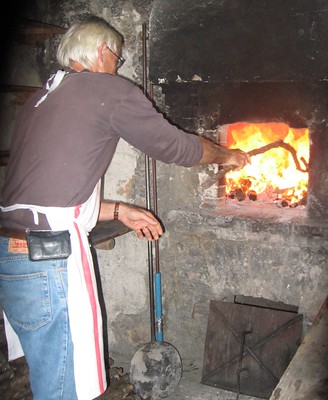
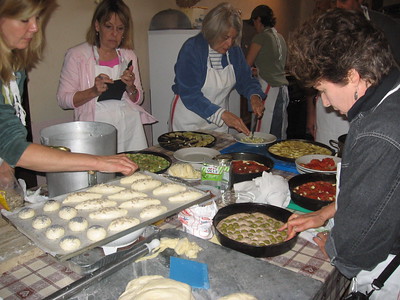
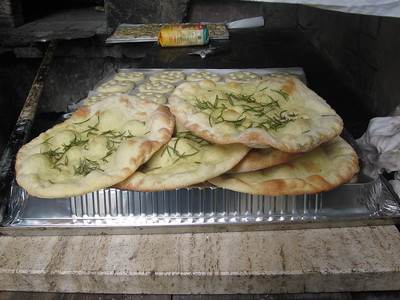
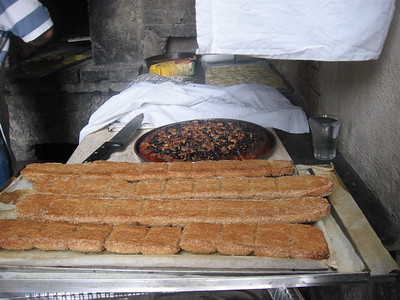
    Friday arrived still damp and threatening more rain. The agenda for the morning was baking with Stefano, a professional baker who took a day off to show us his artistry with dough and a wood burning brick oven. The first step was for Charlie to begin the fire in the oven while Stefano prepared all the goodies to be baked in it later that morning, with the help of the class who hovered around the table in the fattoria kitchen.

    I was not feeling great that morning so I decided to drift in and out with my camera rather than handle the food ingredients. Sandino needed some down time so he slept late and then disappeared into the villa library for a few quiet hours.

    The main thing that I got from watching and listening to Stefano was that he truly loved his work and considered that passion to be vital. Several times he said, “To make bread is nothing. What is difficult is to bake.” He was a real food artisan.

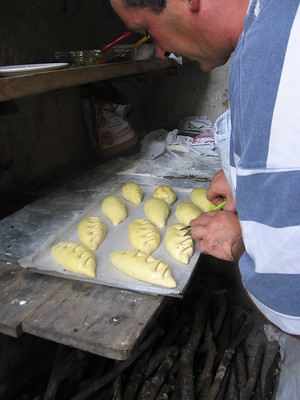
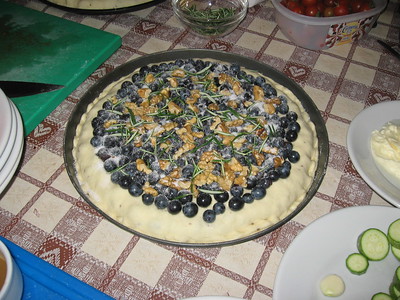
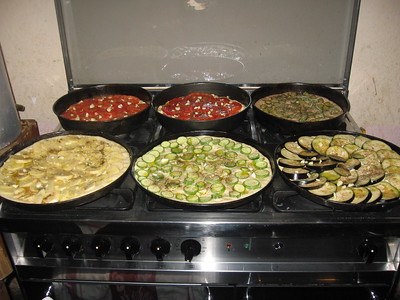
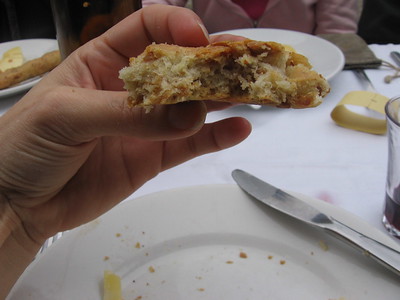
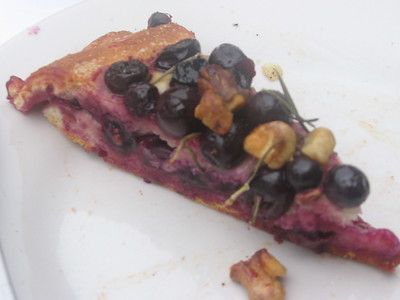
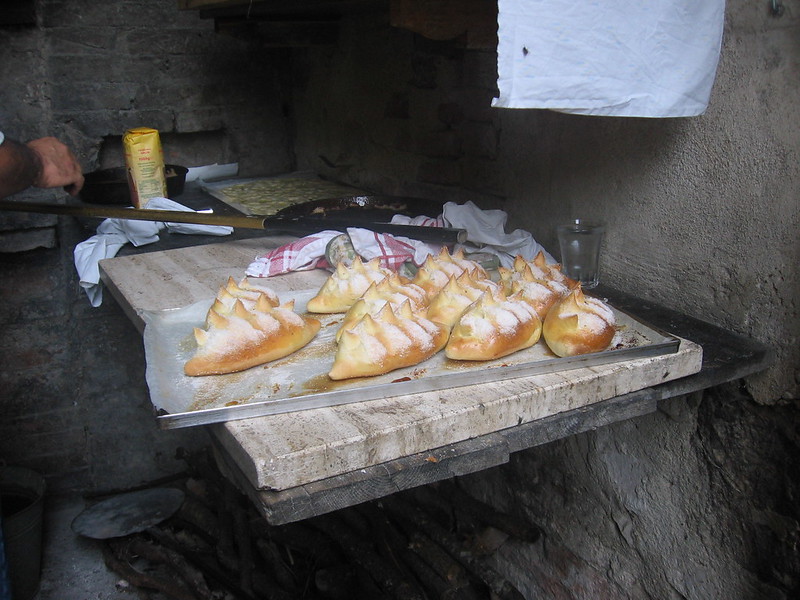
    He turned out an incredible amount of baked goods in just a few hours, including sciachata con uva, a grape tart with rosemary and walnuts, several different focaccie and pizzettine, and a peasant bread that was filled with “all the leftover parts of the pig.” This sounded awful, but it was delicious, just as he said it would be. He snipped some rolls with scissors to raise a spiked crown on top, and sprinkled sugar into the spaces. We had these for breakfast the next two days.

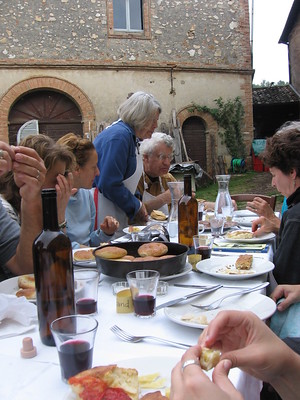
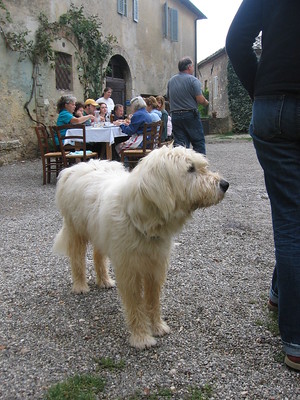
    The weather lifted for long enough that we were able to set up tables out in the courtyard and have lunch as the different dishes came out of the brick oven. Staff members and family from Spannocchia and Lapo the sheepdog drifted around and munched happily with us. Debby said, “Doesn’t it remind you of a Fellini movie?”

    Hope you’re near some good food right now. If not, do forgive me.

    294401114_b5cff880a7_w

    294399486_ee3f900a92_w

    To be continued…


  • Thursday, 19 ottobre 2006
    (Continued from Working at Spannocchia)

    That afternoon brought a chilly drizzly rain. Sandino did a big load of laundry that morning, and since Spannocchia does not have a dryer, we ended up hanging damp clothes all over our room. These wouldn’t get dry until the morning we left.

    Debby led an informal “drawing on the right side of the brain” in the small parlor where a few of us did contour drawings of a still life and each other. The rest of the group played chess, napped, and read in the large parlor near the fire. I found a beautiful slim cookbook with color pastel illustrations entitled A Table in Tuscany, by Leslie Forbes. It is out of print but I ordered it from a used dealer when I returned to the States, and I’m really glad I bought it.

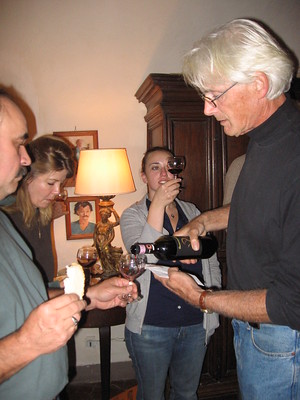
    Later that afternoon, we expected a rep to lead a wine tasting of Brunello wines, which are known to be very fine, and have a chance to buy them at a good price. However, there was a mix-up about the date and Charlie ended up leading the group in a tasting of wines he had bought. He did a great job, despite a little choking episode that gave us all a chuckle, because he has the imaginative verbal skills to pull it off. I have a very hard time matching words to tastes. To me, wine tastes sweet or dry, smooth or bitter, and like grapes. That’s about the extent of what I can come up with.

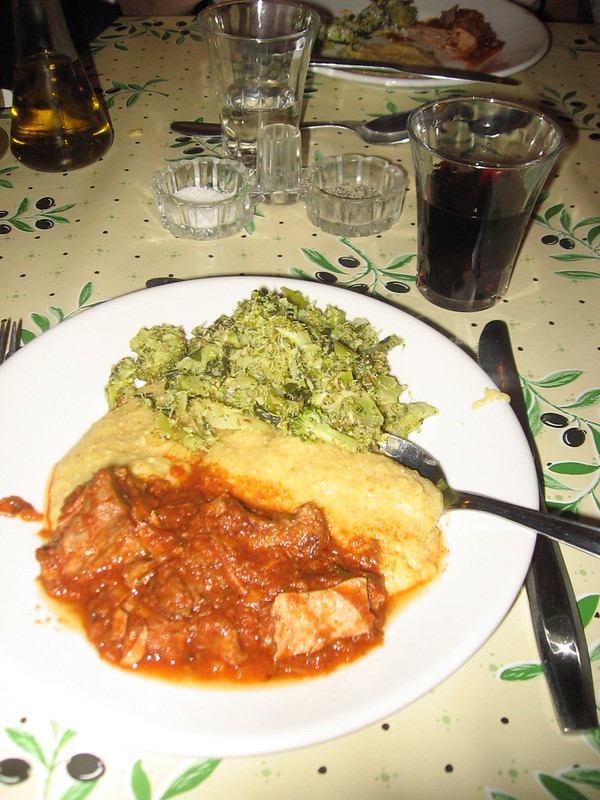
    Dinner that night was superb, as usual, but perhaps even a little more towards a unique Spannocchian experience:

    Primo: Zuppa di Porri (leek soup)
    Secondo: Polenta con Cinghiale (Polenta with stewed wild boar)
    Contorno: Broccoli
    Insalata
    Dolce: Zuppa Inglese (I don’t remember this one! Probably too stuffed from the cinghiale.)

    This is the meal that Sandino keeps telling our friends about. Was it our favorite? I don’t know – every meal at Spannocchia was simply amazing.

    To be continued…

  • Wednesday, 18 ottobre 2006

    We returned to Spannocchia that evening, where it was pizza night. Pizza night was a big deal at Spannocchia, when the wood-burning brick oven was fired up that afternoon and interns dressed up a bit for the evening. We sang happy birthday to my friend Deb Bettini, who celebrated a big one that day. Pizza after pizza was delivered to the dining room until no one could even consider one more delicious bite. Until the amaretto “truffles,” anyway.

    Thursday, 19 ottobre 2006

    This morning was work time for our half of the class, while the folks who had worked on Tuesday morning had their cooking lesson with Loredana.

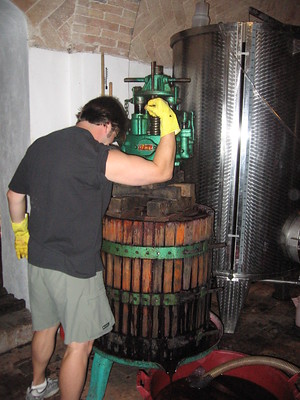
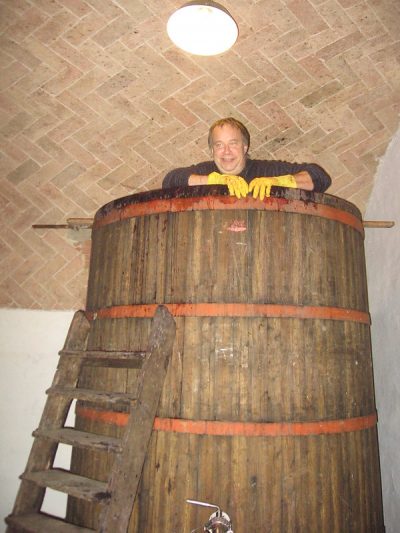
    First, Charlie took us into the cantina where the wine is pressed, stored, and bottled. Karl-Heinz, whose hobby is home-brewing, was particularly interested in the wine making process so he ended up working in here.

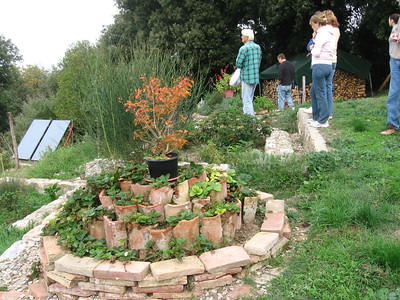
    Then Charlie took us on a short tour of Spannocchia wastewater system. In their efforts to return the estate to a more sustainable ecosystem, both graywater and blackwater natural systems were built to recycle the water back to the land. Part of Charlie’s role in his work at Spannocchia through the volunteer organization WWOOF was in planting the terraces with plants that would naturally filter their water as well as provide beauty. Charlie put many other permaculture methods to work at Spannocchia, including herb spirals.

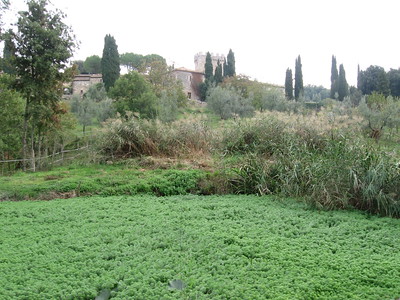
    The verdant photo to the right is the end product of the gray/blackwater system, a small lagoon where the used water from Spannocchia eventually ends up. By the time it filters through the septic tank, which catches the fats, oils, and sludge, and the natural system, it has no smell and can be used to fertilize the fruit orchards and is pumped back to the buildings with solar power pump to flush the toilets. The plants growing on top of the ponds can be scooped off and composted. Rainwater from the roofs is also directed to the pond. Since Tuscany is prone to periods of drought, this saves the use of fresh water from San Bernandino’s spring.

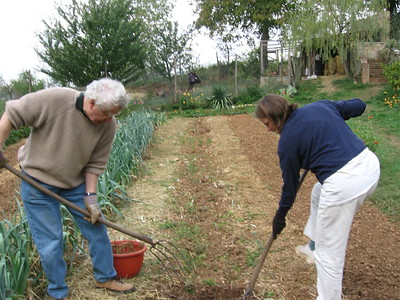
    At this point, the group split up, most of us going to work on repairing a fallen stone wall. I was quick to volunteer to help turn over a row in Carmen’s orto, along with Wood. Even if it was just using a pitchfork and pulling grass roots and rocks out of the dirt, I was grateful for an opportunity to work in the garden. Leeks had been grown in this row and Carmen was preparing it for a cover crop. The soil was rocky enough that I bent a tine on my sturdy pitchfork badly enough that we couldn’t use it and couldn’t bend it back. Whoops. Later, when talking with Debby about volunteer work, I found out that working in the vegetable gardens is a primo assignment, usually saved for interns. We were asked to help because the two interns were getting over being ill.

    Sandino jumped at the chance to help out in the cantina after deciding that he didn’t have the knack for masonry. Not to disappoint you “I Love Lucy” fans, but he was scooping out the mashed skins and pulp with a bucket, not stomping grapes. He had on rubber boots. It was hard work and his clothes were purple and pungent by the time Charlie rescued him and Karl-Heinz from their labors to play chess.

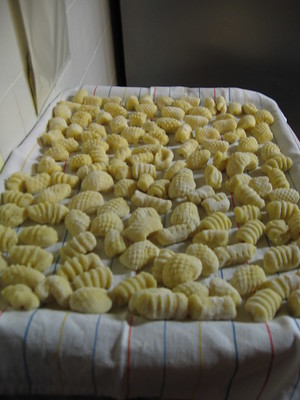
    Meanwhile, the folks in the cucina (kitchen) were having their cooking lesson with Loredana. For the primo piatta, they made gnocchi, which I never cared for until trying THIS version. They made the patterns with forks and by rolling them over a cheese grater. The secondo was saltimbuca (veal rolls), and the contorno (side dish) was one of my favorites, finocchio (braised fennel). For dolce (dessert), salame chocolat. Oh! molto bene. I have this in my notes: “Cooking class had pears with gorgonzola – jealousy!” I hope that I’ll be able to get these recipes from them.

    To be continued…

  • Wednesday, 18 ottobre 2006

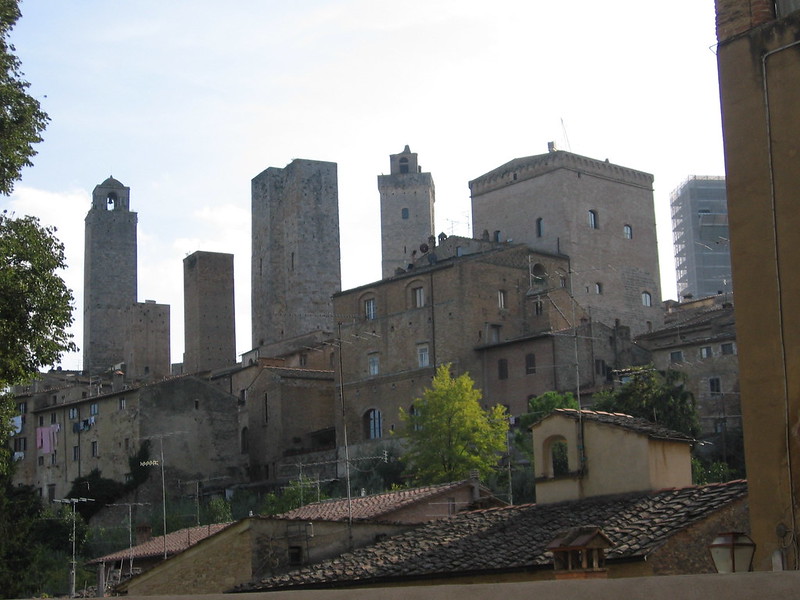
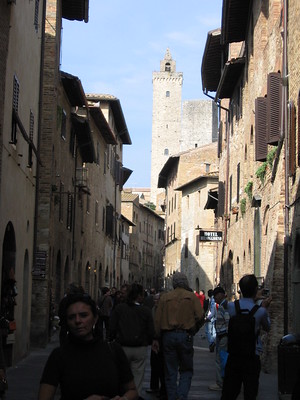
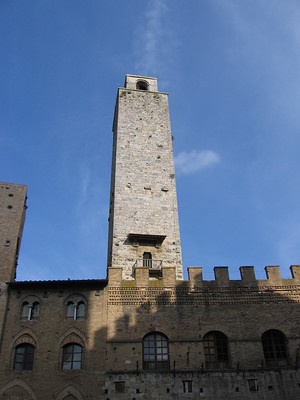
    San Gimignano is called the “medieval Manhattan” because of its many towers. It is one of the most beautiful Tuscan hill towns, making it a mecca for tourists. The city itself was lovely, but the views from it were absolutely stunning.

    Our bus parked near the bottom of the hill and we walked up to the center of this pedestrian-friendly town. I immediately made a beeline to the farmacia, which was in the center piazza, marked, as all pharmacies are, by a green cross. Italian towns don’t have the big stores that offer everything – each little store has its niche. When I got there, the farmacia had just closed at 2 for an afternoon break until 4:30. Knowing that pharmacies stagger their hours in Firenze, I stepped into the tourist information station next door.

    I stood at the counter until it was obvious the person behind the counter was not going to acknowledge my presence, then said, “Scuse…”

    She looked up at me with irritation. “Is there another farmacia in town?” I asked meekly.

    “It opens at four!” she snapped and looked back down at her magazine.

    “But,” I tried again, “is there another farmacia in town?”

    “NO!” she barked, not bothering to look up this time.

    I have to admit that when I was told to go to these tourist information stations for the best information, no one said that they had to be polite about it. But my irritation at her rudeness got my mind off my queasy stomach long enough that I realized that I’d be okay until 4:30. Although, by God, that pharmacy had BETTER open back up. I had little trust in my luck in this matter by now.

    By this time I had totally lost Sandino, so I wandered around the little shops and galleries in town. This was the first length of time I spent on the trip when I was not compulsively snapping photos, because Sandino had the camera. I felt the pangs of addiction, and then I enjoyed my solitude. I talked to a tapestry weaver who incorporated his tapestries into sweaters and shawls. I watched a potter turn tall bottles in his studio shop. I climbed up to the highest level and sat, looking out over the landscape.

    There was one disjointed moment in a gift shop when “Stuck in the Middle with You” was playing over the sound system.

    I went into an art supply shop to buy a sketchbook, and the proprietor, an older man, did not switch to English when I attempted to speak Italian. We spoke at length about colors, etc. and I was delighted every time I made sense! He was quite friendly and patient and addressed me formally, using Lei, which impressed me. I selected several small items and totaled it up as costing 25 euros, handing him the money. He asked me if I had one euro, and I assumed that I had miscalculated the price and it was 26. Then he handed me five euros back. He had given me a discount without me asking for it. This was the only time I experienced such Italian charm (other than Spannocchia), and I appreciated the encounter.

    Finally, the farmacia opened and I bought 10 pieces of Dramamine gum for 10 euros. That came to about $1.30 a piece, and they were worth every penny. Even though San Gimignano was a tourist town, I noticed that the prices still seemed lower than Firenze. I bought a cheese grater in a olive wood box, a purchase I would later find to be unusable, but it’s pretty.

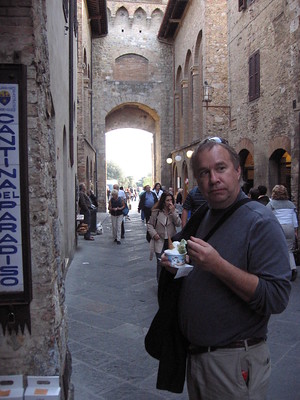
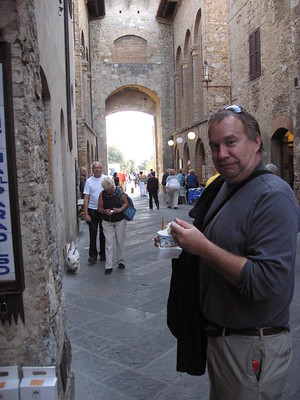
    I kept running into classmates (this was a really small town) who told me that Sandino was looking for me. We finally found each other and treated ourselves to gelati. I recovered my precious camera and snapped a photo, looked at it, and told him he would hate it because he was eating ice cream with his stomach poked out. So he posed for another one sucking it in.

    At the bottom of the hill, before getting on the bus, I finally had my first European squat and pee experience in a public bathroom. I had wondered what the heck everyone had been talking about – except for some differences in how to flush them, the toilets so far had all been familiar sit-down versions. It’s not so bad, there are ridged tiles that you put your feet on and a handrail for balance. And no, the toilet paper was not like wax paper, or craft paper. It was regular toilet paper. It was given to you by an attendant as you walked in, who you tipped.

    Sandino is responsible for the other photos in this post.

    To be continued…

  • Wednesday, 18 ottobre 2006

    After an early breakfast and a spectacular sunrise, we all got on a rented bus to go to a biodynamic farm, Poggio Antico, and then to San Gimignano for a much anticipated field trip.

    This day was bittersweet for me – my excitement about riding through the hills of Tuscany and seeing all the beautiful landscapes turned to horror when I became extremely carsick after only reaching the end of the road from Spannocchia. I could not look out the windows and struggled for a little over an hour not to get sick on my favorite jacket on the bus. I don’t remember ever being so sick in a situation that I could not stop and get out. It was sheer hell and I was doubly miserable because I was missing all the beautiful scenes of Tuscany that I was hearing discussed around me. All I could do was sweat and focus on not throwing up.

    THAT was what I forgot to buy in Firenze. Dramamine. Again.

    The bus driver was very unhappy about driving on the “white roads” and Charlie and Debby were in constant negotiation with him. “Next time you rent jeep!” he said over his shoulder as we hit a section like a washboard.

    I stumbled off the bus at Poggio Antico green to the gills, but I made it through. Then I had to deal with it again on the way to San Gimignano, but this time it was not so long a ride and I sat in the front seat.

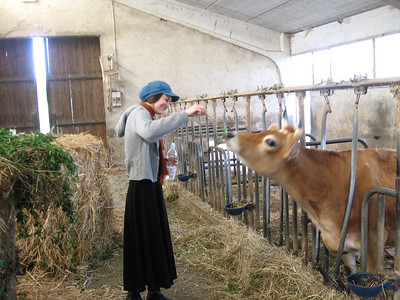
    Poggio Antico was a lovely farm community. A lot of different foods are produced at Poggio Antico and you could buy many of their products on site. We went into a barn where dairy cows were, for various reasons, inside, and Roberto explained their philosophy, which I will not try to explain here because biodynamic agriculture is very complicated. I’ll just say that biodynamic farmers have particular methods and additives that they use to raise the vitality of the soil, and they are very attuned to nature.

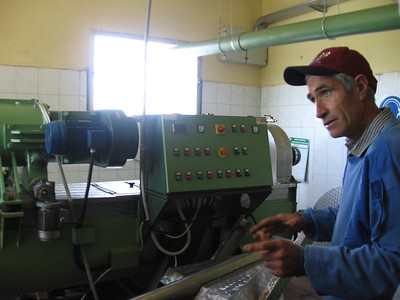
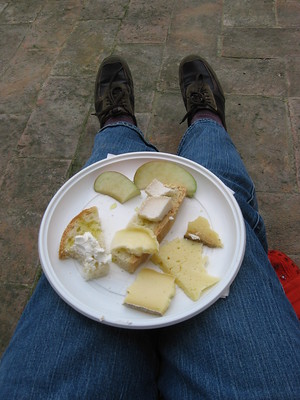
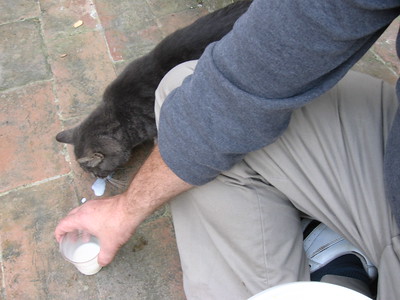
    Roberto told us about the process of growing, harvesting, and pressing the olives into oil in their modern frantoio (olive mill). Afterwards, we went into the farm’s store and bought olive oil, pasta, and other products to take back with us. Charlie and Debby bought a variety of cheeses for our picnic, which we tasted along with fresh fruit and salad. A big treat for Sandy and me was a bottle of raw milk that we shared, with just a little for one of the farm cats. Sandy was bowled over by the freshness and taste and so was I. But I grew up drinking raw milk – he had never tasted it. Hopefully we will get a chance to buy this legally in the coming year. Although it is illegal to sell raw milk in most U.S. states, including North Carolina, it is not illegal to drink milk from your own cow, and we may get a chance to buy a cow share from a local farmer.

    To be continued…

  • 288534297_c5197d4d7c_c

    Wednesday, 18 ottobre 2006

    I am thankful that I was able to see this sunrise at Spannocchia.

  • Tuesday, 17 ottobre 2006

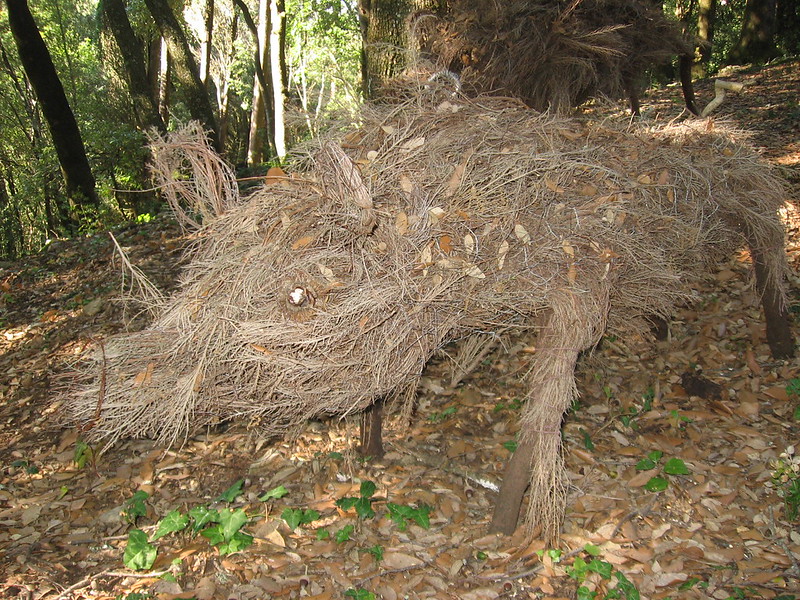
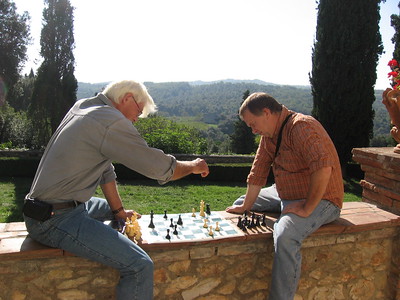
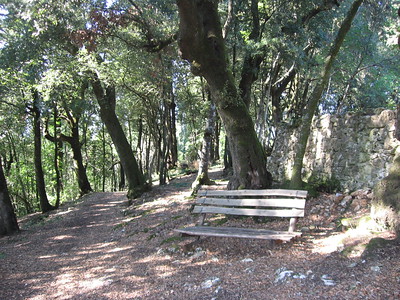
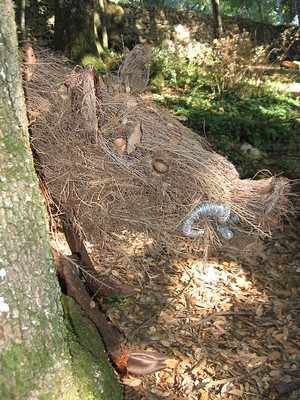
    After that incredible lunch, we had a little bit of time to relax. Sandino played chess with Charlie, and I spent some quiet time in il giardino segreto (the secret garden) with a book, my notebook, and camera. I didn’t go far, since I was trying to heal my foot before our big road trip to Poggio Antico andSan Gimignano the next day. But I found some interesting fiber sculptures just off the trail.

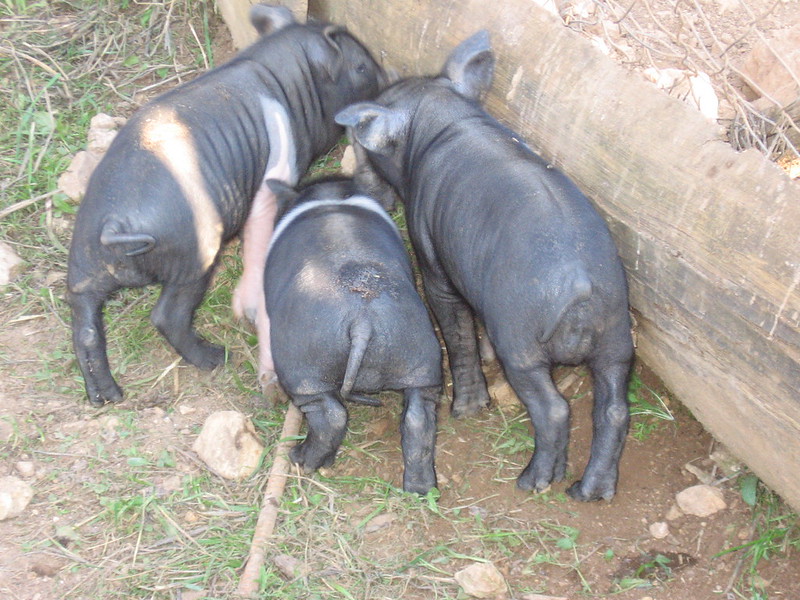
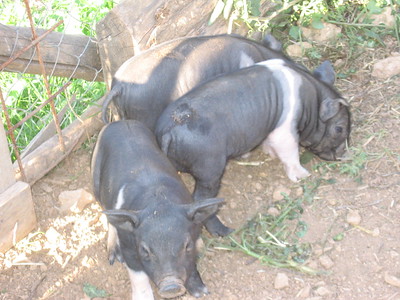
    Later that afternoon, the class took a tour of the Cinta Senese pigs, an heritage breed making a comeback at Spannocchia. The Cinta Senese are perfectly adapted to the woodlands of Spannocchia, where they are raised with care in fenced areas. The little piggies above are only one week old.

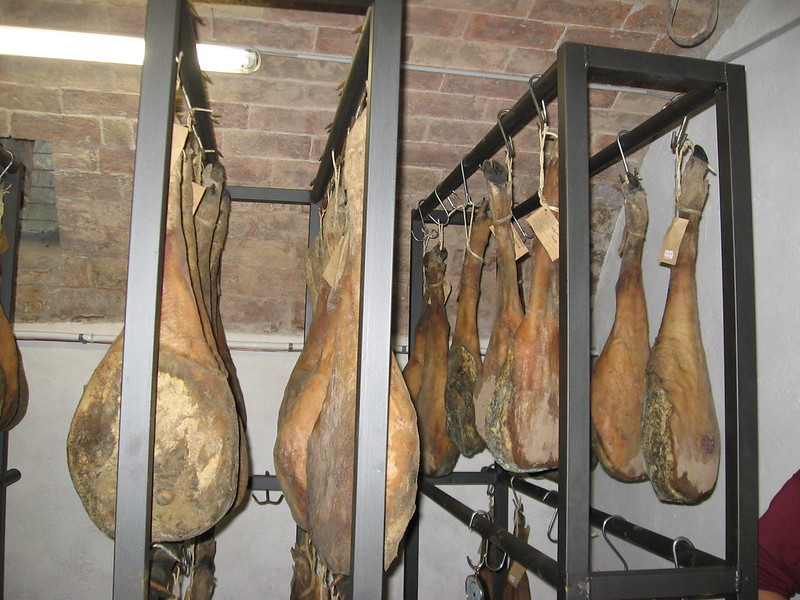
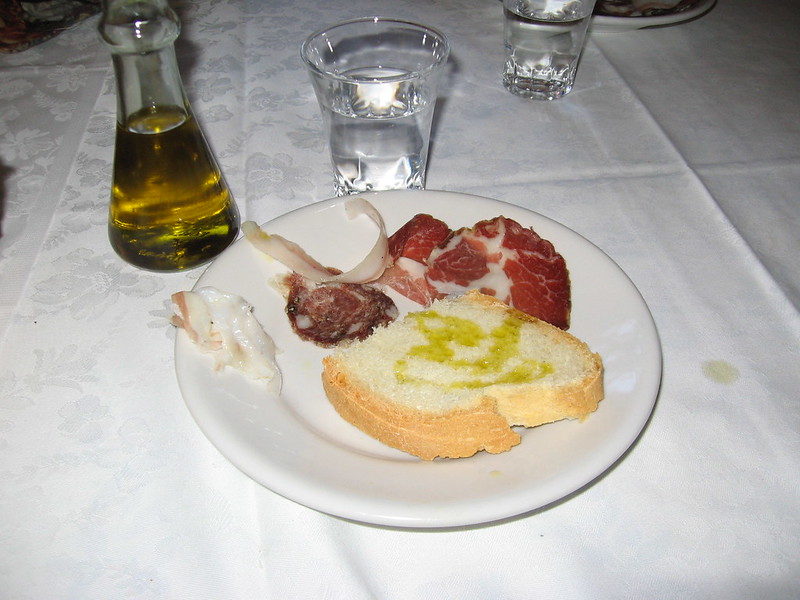
    The tour concluded with a visit to a basement storage room where prosciutto hangs to cure, and a tasting of the different items that are produced from the farm’s pork. I heartily support and applaud small livestock farmers who produce their own meat with love and care, but I have a hard time meeting the animals that I eat. Plus I just recently began eating pork again after years of not eating it for a variety of reasons. Even though we didn’t meet the specific animals that we ate, it was psychologically difficult. But I tried all of it, and enjoyed the salume the most. We ate these again on pizza night and on Friday, when we had lunch outside in the courtyard.

    Coincidentally, there was an opinion piece in the NYT today, Cure Me, about the sad inflexibility of the USDA in prohibiting the sale of traditionally cured meat in this country. This is why I can’t find locally-produced ham or bacon that is traditionally cured without nitrates. The USDA is not interested in putting more effort into monitoring food production or inspecting meat for safety, and they make decisions based on what is best for big agribusiness, not for consumers or independent farmers. When I was growing up I remember when my godfather, Mr. Wade, brought us a cured ham, which we hung in our unheated utility room. You have to cure it yourself or have connections to get this kind of good food in the U.S. now.


    My photos from the dinner that night did not come out, but here’s the menu for the record:
    Primo – Risotto con spinaci (risotto with spinach)
    Secondo – Arrosto (literally, roasted meat; specifically, veal with mushrooms)
    Contorno – Porri (baked leeks – so good!)
    Insalata (salad – radicchio)
    Dolce – Dolce alla Frutta Fresca (literally – sweet with fresh fruit)

    To be continued…

  • Tuesday, 17 ottobre 2006

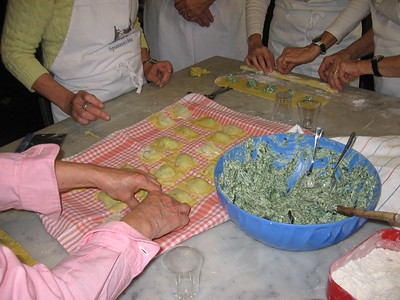
    A couple of weeks ago, I posted a short paper that I wrote about the history and culture of pasta in Italy. Part of the project was learning to make my own fresh pasta, so I documented this part of our cooking class with Loredana in great detail! (Thank you, Teresa, who filled in as photographer while I mixed and kneaded dough.)

    After these photos is the second part of my paper, in which I wrote about my first foray into pasta-making at home.
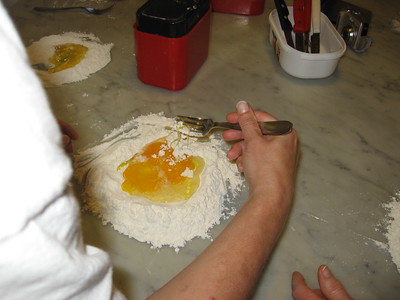
    With the flour, make a mound with a hole in the center then put the other ingredients into the hole.
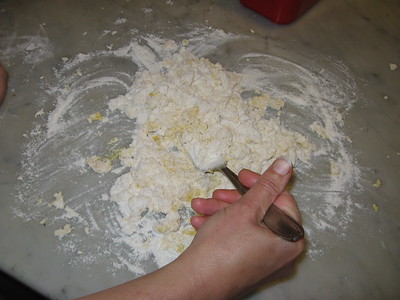
    Mix,
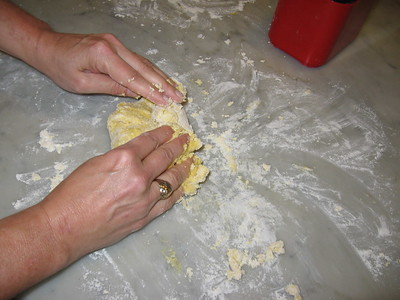
    then knead, into a ball for at least 10 minutes.
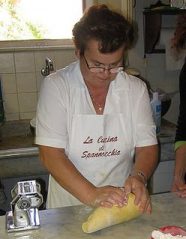
    (Loredana combines all our little balls and kneads.)
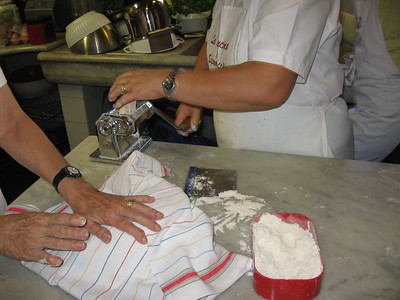
    Cover the dough with a damp towel.
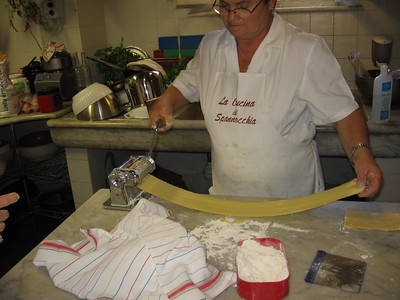
    Divide into several pieces, and then put the pieces through the pasta maker several times.
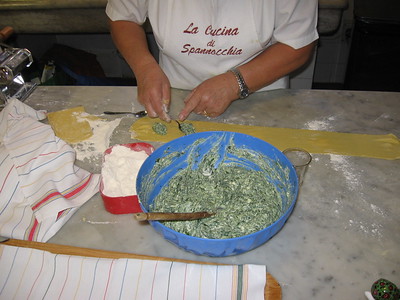
    When the pasta is thin enough, lay out in strips and add a small spoonful of filling every 3 inches or so. Make sure you leave space between the filling to cut into individual ravioli.
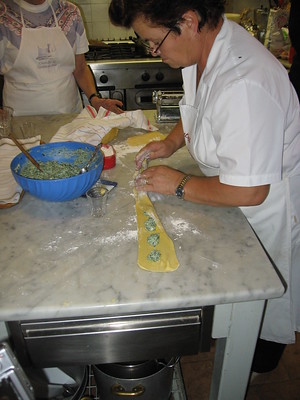
    Fold over the pasta to close it,
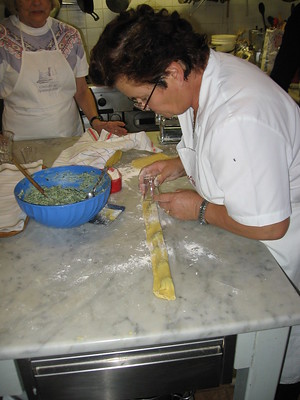
    then press down around the filling with a tiny cup to seal the pasta closed.
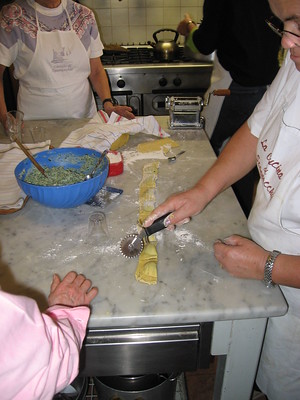
    Cut individual ravioli apart.

    (We all pitch in making the ravioli and put the finished ones on a towel as we work.)
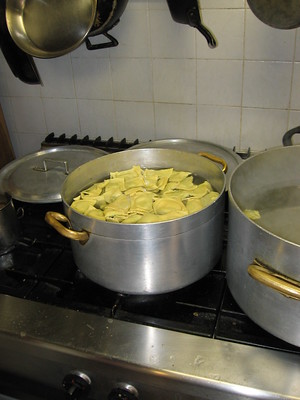
    When all are ready, dump them into boiling water for just a few minutes, or until cooked. You may need to do two batches so that they don’t stick together.
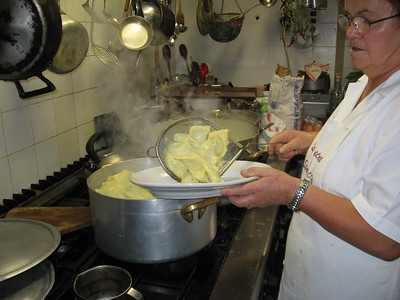
    After draining them, immediately add butter and sage sauce and serve.
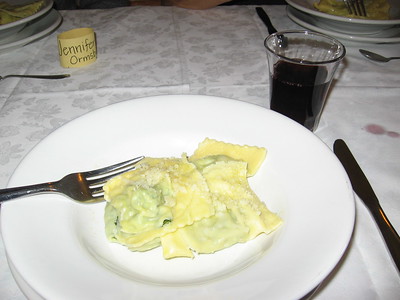
    (Put it on a plate and gobble it up!)

    Ravioli di Spinaci e Ricotta con burro e salvia
    (Stuffed Spinach Ravioli with Butter and Sage Sauce)
    6 servings

    6 eggs
    600 grams of flour (roughly ¾ lb. or 2 ½ cups)
    3 spoonfuls of oil
    A pinch of salt

    With the flour, make a mound with a hole in the center then put the other ingredients into the hole. Mix, then knead, into a ball for at least 10 minutes.

    Divide into several pieces, and then put the pieces through the pasta maker several times (you can also roll it out with a rolling pin). When the pasta is thin enough, lay out in strips and add a small spoonful of filling every 3 inches or so. Make sure you leave space between the filling to cut into individual ravioli. Fold over the pasta to close it, then press down around the filling with a tiny cup to seal the pasta closed. Cut individual ravioli apart. When all are ready, dump them into boiling water for just a few minutes, or until cooked. You may need to do two batches so that they don’t stick together. After draining them, immediately add butter and sage sauce and serve.

    Ravioli Filling
    2-3 cups of cooked spinach
    2 ½ cups ricotta
    1 egg
    3 spoonfuls of grated parmesan cheese
    Pinch of nutmeg
    Salt and pepper

    Mix all together. Salt and pepper to taste.

    Sauce

    ¾ stick of butter
    8-10 sage leaves

    Melt butter, add several sage leaves. Heat until melted, at which time it is ready to serve over ravioli.

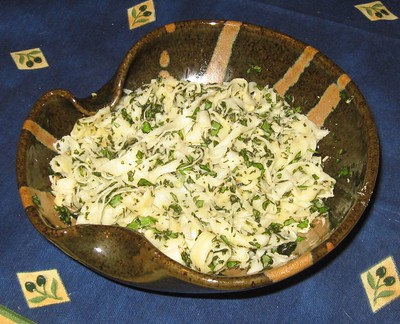
    Upon arriving at home, I decided to try two different pasta dishes. We returned to a cold snap in North Carolina, and the rest of my basil needed to be harvested. I had most of the equipment I needed, but I decided to invest in a pasta machine and a mezzaluna, a rounded knife with two handles that is ideal for chopping herbs and garlic.
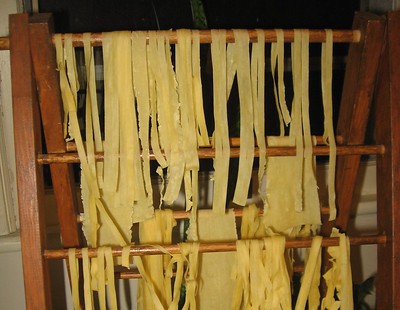
    I had found in our lesson with Loredana that the making of pasta is really not that difficult. As Elizabeth David points out, traditional Italian food often requires long preparation and short cooking times. Italian cooks often do not give exact measurements of ingredients; assuming that we should be able to judge how much a spoonful or a teacupful should be. The first question about measurements I ran into occurred at the very beginning of my solo pasta adventure – Loredana’s recipe called for 6 eggs, 2 ½ cups of flour, 3 spoonfuls of oil, and salt. My eggs were extra-large, and other recipes I had for pasta called for approximately one egg per cup of flour. I decided to use three extra-large eggs, and when the dough seemed much drier than the dough we had made in Spannocchia, I added another splash of oil. At that point it was impossible to add another egg. It was very stiff dough, but it all came out just fine. But should I decide to make stuffed pasta, I will add more egg.

    After following Loredana’s instructions, I sliced off sections and ran it through the pasta machine on successively smaller settings, until the dough was silky thin. Later when I cooked the pasta I found the lowest setting to be too delicate for my tastes, and will probably make it a bit thicker in the future. Part of the dough I left in wide strips to be used in a lasagne for our meals over the next few days, and part of the dough I ran through the fettucine attachment. I draped these over a rack under a damp dishtowel as I worked.

    The following recipes are copied from La Cucina di Spannocchia, a cookbook published by the Spannocchia Foundation. My changes or additions are in brackets.

    Pesto
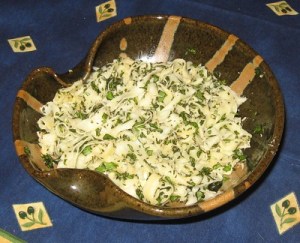
    [Cook fresh tagliatelle in boiling water until al dente (2-3 minutes, tops). Top with pesto:]

    “2-3 cups fresh basil leaves
    ¼ c pine nuts
    ¼ cup parmigiano, grated
    [1 large clove garlic]
    Extra virgin olive oil

    “Combine all ingredients in a food processor and puree till smooth, adding oil to achieve the desired consistency. [I chopped everything together on a cutting board with a mezzaluna.] Taste for salt, adding if necessary. Toss with linguini, spaghetti, or orecchiette, add a couple tablespoons of butter and additional cheese, and serve. Or freeze in containers to use later, when the peppery taste of basil will bring summertime to your winter table!”
    (Cucina, 28)
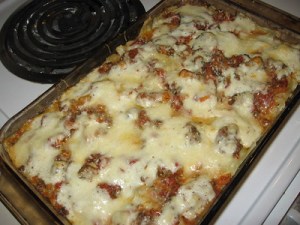
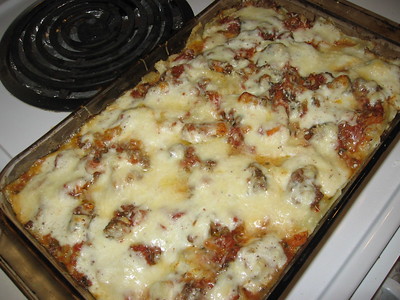
    Lasagna

    Lasagna sheets
    Ragù sauce (recipe follows)
    Besciamella sauce (recipe follows)
    Grated parmigiano

    “Cook the pasta in boiling, salted water until al dente, toss with olive oil to prevent sticking. Place a thin layer of ragu in the bottom of a large baking dish. Lay the lasagna noodles on top, cutting the ends to fit the pan. Layer the ragu and besciamella, sprinkle a generous layer of parmigiano, and continue until the pan is full. Bake at 375 until bubbly at edges.”

    Ragù [divided in half makes plenty for a pan of lasagna]

    1 medium onion, chopped
    2 stalks celery, chopped
    2 carrots, chopped
    2 cloves garlic
    2 tbls tomato paste
    ½ cup red wine
    ½ cup or more olive oil
    2 tbls parsley [I used basil]
    2 lbs finely ground meat: pancetta, pork, veal, beef, sausage: a combination of meats makes a more complex sauce
    8 cups crushed tomatoes [I used home-canned chopped tomatoes]
    Salt and pepper

    “Saute meat in a large pot until browned, remove the meat and set aside. Finely mince the first four ingredients in a food processor [I used a mezzaluna], sauté in olive oil over medium heat until soft but not browned, about 15 minutes. Add tomato paste and sauté for 5 minutes, return meats to pan and deglaze with red wine. Add parsley [basil] and tomatoes and allow to cook over a low heat for several hours, being careful not to burn. Season with salt and fresh ground pepper.”

    Besciamella (béchamel) [Again, I divided this in half]

    4 tbls butter
    4 tbls flour
    4 cups milk, heated
    Salt and pepper
    Ground nutmeg

    “Melt butter on a medium heat, add the flour, stiffing constantly until flour is absorbed. This forms a roux and should be allowed to gently cook for a few minutes to allow the flour taste to cook out. As a white sauce, besciamella requires a light roux, so be careful not to brown.

    “Add the hot milk slowly, whisking in to dissolve any lumps that may form. Add a good amount of salt, pepper, and nutmeg to taste. Continue whisking over medium heat, adding milk if too thick, until the sauce reaches the desired consistency. It should be relatively thick yet pourable.”
    (Cucina, 29-31)

    To be continued…