I just wrote a short research paper for my class, you know, the one that went to Italy? Turns out that we had to do something other than drink wine and eat heartily for credit. Bummer!
Now I can get back to writing up my journal.
Here’s part of my paper. The other part is on another post: Making Ravioli with Loredana.
Pasta in Italy, Past and Present
Many people recall being surprised by the widespread tale that pasta, the food product for which Italy is most famous, was brought to Italy from China by Marco Polo. Any work that addresses the history and culture of pasta begins with debunking this myth. While it is true that the Far East has a tradition of noodles that predates Europe’s traditions, it is also true that pasta, made from a variety of grains, was developed in many different areas of the world at different times in history. The reason is simple: pasta is one of the most practical, inexpensive foods on earth. A basic combination of flour and water, its name means “paste.” It could be preserved by drying and reconstituted as a filling, nutritious meal later. Depending on the sauce used to top it or stuff it or layer with it, pasta could be decadent or simply life-sustaining, easily adapting to whatever else was on hand.
Italy became a center of pasta culture and business because it was supremely well-suited for it. Most food historians now believe that the first Italian pasta was produced in Sicily, brought across the Mediterranean Sea by Arabic sailors and traders. Al-Kitab al-Rujari, written by an Arab geographer in 1154 A.D., says about Sicily, “there is the town of Trabia, enchanting place, rich in perennial waters and wheat mills, where they produce food out of flour, an abundance of pasta in the shape of strings which are exported to Calabria and many Muslim and Christian countries, even by ship.” (de Vita, Who) The word used for pasta is the Arabic “itriyah,” which means “bread cut into strips.” (Mondelli, 2) The dry climate of Southern Italy was ideal for storing dried pasta, and the forests of Sicily were cut down to devote its land to growing wheat for the Roman Empire. (Bugialli, Fine, 156)
Although it is thought that pastilli, small grains of pasta made from toasted wheat, was eaten as long ago as 490 B.C., the first mention of pasta in literature is written by Q. Horace Flaccus in 35 B.C., when he describes a meal that includes “leaks, chick peas, and lagane.” “Lagane” itself is described a few hundred years later by Apicio in a dish layered with meat and sauce as “a sheet of pasta” to be broken and boiled. (Mondelli, 2) “Lagane,” is from the Greek “laganon,” a flat dough that was sliced into strips, and the Latin word “laganum.” The term is still used in Southern Italy today for “lasagne.” (DelConte)
Another proof of pasta in Italy before the time of Marco Polo comes from a relief carved on an Etruscan tomb that depicts various tools used in the making of pasta, including a jug, board, knife, “laganatura” or long rolling pin, and pastry wheel. (DelConte)
In the example used most often by food historians, a will ceding a chest or “bowl full of maccheroni,” was drawn up in 1279 Genoa. Sixteen years later, Marco Polo returned from China and declared that the lasagne made with “tree flour” there was “as good as the ones I have tasted many times in Italy,” settling the argument that Italian pasta may have originated with the famous explorer’s visit to the East. (Mondelli, 2)
Originally, pasta dough was kneaded by men with their feet on “a large flat board with high edges,” adding water and taking turns before handing the dough over to the women. The kneading bar was introduced in the sixteenth century, which simply introduced a panel on top that the worker “[sat and hopped] on the edge of it.” Kneading the dough quickly to prevent fermentation and in large quantities remained a challenge but improvements in “kneaders” continued until the twentieth century, when a worker in a brick factory took inspiration from a machine and invented a machine that kneaded and pressed the dough into shapes. Modern machines now replace human hands, feet, and behinds in the manufacture of commercial pasta. (De Vita, From 1)
Pasta makers began to separate from bakers and form confederations in the sixteenth and seventeenth centuries. Apprentices were expected to serve under experienced makers and had to provide their own equipment. With the introduction of the die, used with a press to make hundreds of different shapes, the first pasta factories began to appear in Naples in the seventeenth century. (De Vita, From 1) The Industrial Revolution of the nineteenth century rapidly expanded the mass production of dried pasta, with innovations such as the mechanical kneading trough and the hydraulic press, and as a result replaced many human workers with machines. (Mondelli, 5)
In the 1930s, an Italian futurist poet name Marinetti set off a firestorm of debate when he denounced “the absurd Italian gastronomic religion,” pasta. He and his supporters maintained that “Pastasciutta, however grateful to the palate, is an obsolete food; it is heavy, brutalizing, and gross; its nutritive qualities are deceptive; it induces skepticism, sloth, and pessimism.” Mussolini, although he admired the outspoken Marinetti for his nationalistic stands, (David, 65-66) ordered many acres of central and northern Italian farmland to be planted in wheat, with the aim that Italy should be self-sufficient in its grain needs, resulting in the movement of pasta production away from its Southern roots. (DelConte)
Today, large corporations such as Barilla, founded in Parma in 1887, and De Cicco produce thousands of tons of pasta made from imported and domestic wheat to be shipped all over the world. The major pasta manufacturing area centers on the town of Fara San Martino in the region of Abruzzo, near the foot of the Mariello Mountains, where the spring waters are of high quality. The second largest pasta exporter in the world, De Cicco, was founded in Fara San Martino in 1887, but since then many other pasta producers of smaller size have been drawn there by the superior taste of the water as well. Italy can no longer produce the vast amounts of grain needed to produce this kind of volume, so large companies like De Cicco use a blend of semolina flours from several countries. (Callen)
Smaller artisanal and organic companies such as Bionaturae, based in Pisa, and Nonna Luisa depend on older traditions in the manufacture of their pastas. For example, Bionaturae buys its organic grains from Italian small farms and its presses use antique bronze dies. (Bionaturae) Nonna Luisa hires consultants from older traditional small pasta factories. Artisanal factories also take pride in their drying processes, using either the sun or solar mimicking processes to dry their products slowly, rather than flash-drying them with super-high heat. (Callen) The use of bronze dies imparts a slight roughness to the texture that enables the sauce to adhere to the pasta more easily. (Bionaturae) Modern technology has moved toward using Teflon dies, which have a much longer life and perform most reliably, but they produce a smooth surface, which is not preferred by pasta connoisseurs. (Dry)
Up until the eighteenth century, the most frequently used words for pasta were “maccheroni” and “lasagna.” Rounded long pasta was generally referred to as “vermicelli” or “spaghetti” because of its resemblance to worms or strings. Worldwide, the word “macaroni” came to connotate refinement and riches, explaining the line in the song when Yankee Doodle was so deluded and vain that he “stuck a feather in his cap and called it macaroni.” London had its “Macaroni Club,” open only to the rich gourmets who could afford fine imported foods. (Mondelli, 4)
Stuffed pasta has been enjoyed in Italian cuisine since at least the fourteenth century, when tortelli, another name for ravioli, appears in Florentine cookbooks. Unstuffed pasta made its appearance in upper class dining rooms in the late eighteenth century with the introduction of the three or four pronged fork. Until then it was seen as a sloppy food, eaten gracelessly by common people on the street with their fingers. During the nineteenth century, as pasta production moved northward with the Industrial Revolution, pasta of all kinds became a more frequent part of the formal Italian dinner, first replacing the minestre (soup) course from time to time, and later becoming a regular staple of the primi piatto (first course). (Bugiallo, Fine 156)
Although pasta has been important to the fortunes and cuisine of Italy, it has never had quite the overall importance that the rest of the world tends to ascribe to it. In certain regions of Italy, rice and bread are the most popular foods for grain-based dishes. Nevertheless, pasta is hugely popular all over Italy and the world, and its popularity continues to grow. Regional differences still remain in the preparation of many pasta dishes, and even the names of certain shapes of pasta differ from region to region. As the world becomes smaller, even Italy is seeing a certain amount of loss of food traditions and varieties of pasta as it becomes more homogenized and industrialized. Fortunately, the “white art” of making fresh pasta at home has not been lost.
In the home kitchen today, most pasta begins as a mound of semolina or durum wheat flour with eggs, oil, and/or water mixed into a well at the top. Ingredients to color and flavor the dough may be added to the mix, such as spinach, tomato, herbs, garlic, or even squid ink, which makes the pasta black.
The flour is incorporated gradually into the wet ingredients to form a dough, which is kneaded for at least ten minutes, then allowed to rest. At this point, it can be rolled out onto a board or table with a long smooth rolling pin, called a laganaturo or matterello, (De Vita, From 1) or a ridged rolling pin that patterned the dough, called a troccolo. Another tool for stamping patterns on flat dough is a wooden board with a traditional herringbone design called a cavarola. Most pasta shapes with a center hole such as macaroni are bought as dry, but occasionally a tubed pasta is made by rolling small pieces of dough around a smooth stick like a wooden knitting needle. These can be patterned with the use of a tool called a pettine, which resembles a comb and leaves a slightly ridged pattern on the rolled pastas. (Bugialli, Pasta, 249, 273)
Modern cooks usually employ the use of a pasta machine to stretch and flatten the dough, feeding it around a roller that can be set to different thicknesses. Once the dough is stretched to the desired thickness, it can either be fed through a second roller designed to cut it into lengths of flat or rounded long strands, or it can be laid out on a flat surface to be cut by hand. One cutting tool that has become rare is called the chitarra, named for its resemblance to a guitar. The flattened, stretched dough is laid across strings or wires on a wooden frame and pressed through to cut them into even widths, much like our modern hard-boiled egg slicers. (De Vita, From 1)
Once cut into shapes, the pasta is cooked within thirty minutes, especially if it is stuffed, since it will need to be sealed with the fingers or a fork to keep the ingredients from escaping into the pot. Fresh strands of pasta may be cooked briefly, no longer than a few minutes, and served with a sauce, or they can be dried on a rack to preserve them for later use.
The ingredients used in making fresh pasta vary from region to region, as well as the types of sauces used. In Tuscany, egg. oil and salt are added to the flour, and the preference is for a lighter, more delicate thickness. The Bolognese use a thicker pasta, and the Genoese do not generally use eggs. (Bugialli, Fine 157-158) Names for the same type of pasta vary from region to region as well – for example the fettucine in Rome (and the United States) is more commonly known as tagliatelle in other parts of Italy. Linguine is not commonly known in Italy. Americans are familiar with the different names for varying thicknesses of rounded strands of pasta, but before standardization of length for packaging, there were also different names for different lengths, such as bigoli, which was very long. (Bugialli, Pasta, 10)
Major olive oil producing regions of Italy use the local olive oils in their dishes, and others use the fat that is most available. Thus, northern regions of Italy tend to prepare butter-based sauces, and the region of Campania, which is surrounded by olive producing areas but does not produce much of its own, uses lard. Cheese is used regionally in the same way, with Pecorino used more in the regions of Tuscany than the more famous Parmigiano of the southern regions. Cheese is not added to dishes in Italy with the gusto that Americans are accustomed – it is usually added to pasta before it is served at the table, and often not used at all. (Bugialli, Pasta 11) Favorite herbs and spices vary from region to region as well; basil may be the star of Genovese pesto, but in other regions of Italy, sage, rosemary, parsley, and nutmeg are the preferred seasonings.
Works Cited
Betti, Loredana. In the Spannocchia Kitchen with Loredana. Siena, Italy. 18 October 2006.
Bugialli, Guiliano. Bugialli on Pasta. New York: Simon & Schuster, 1988.
—, The Fine Art of Italian Cooking. New York: Times Books, 1989.
Callen, Anna Teresa.“The World’s Best Pasta.” Food and Wine Magazine. May 1999. 28 October 2006 <http://www.foodandwine.com/articles/the-worlds-best-pasta>.
David, Elizabeth. Italian Food. 3rd ed. New York: Penguin, 1999.
De Vita, Oretta Zanini. “Who invented macaroni?” Professional Pasta. 1 November 2006 <http://www.professionalpasta.it/dir_9/1_whoinv.htm>.
—, “From the ferretto to the die: brief report about the tools to make macaroni.” Professional Pasta. 1 November 2006 <http://www.professionalpasta.it/dir_9/ferretto_01.htm>.
DelConte, Anna. Gastronomy of Italy, quoted in “About Pasta,” e-rcps.com. 2 November 2006 <http://www.e-rcps.com/pasta/basics/pasta.shtml>.
“Dry pasta machines / the die.” Professional Pasta. 1 November 2006 <http://www.professionalpasta.it/dir_3/machines&plants/3_die_1.htm>.
Stipo, Gina, Loredana Betti, Daniela Casarin, and Francesca Stratton. La Cucina di Spannocchia. 2nd Ed. Siena, Italy, 2000.
Mondelli, Mariaelena. “Old and true…like pasta.” Professional Pasta. 1 November 2006 <http://www.professionalpasta.it/dir_9/cron_somm.htm>.
“Organic Pasta.” Bionaturae.com. 6 October 2006 <http://www.bionaturae.com/pasta.html>.
Works Consulted
Hazan, Marcella. The Essentials of Classic Italian Cooking. New York: Knopf. 1992.
Romer, Elizabeth. The Tuscan Year. New York: North Point, 1989.
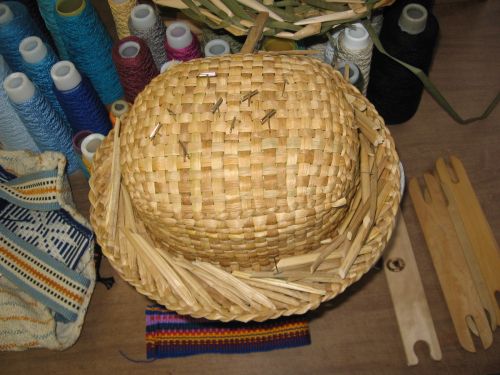
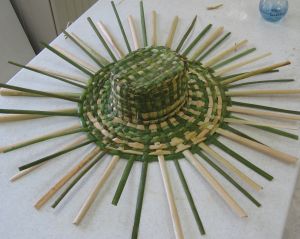 First, I made a wide-brimmed garden hat entirely out of cattail leaves. We used hat forms. They were useful in pinning the weaving close together and keeping the size and shape intact while the hat dried. The cattails separated a lot when they dried.
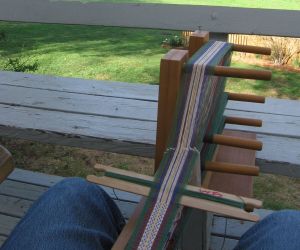 So I decided to give up the raffia hat and make another hat, this time out of cattails and bulrush, with a flat top and short brim. I also decided to weave an inkle band, so that I could switch off to a different activity when my body told me that it had had enough. I’ve woven inkle bands for several years, so I was more interested in learning the basketry techniques. However, it was good to get a refresher on the inkle loom since it has been a while, and I enjoyed weaving on the porch of Keith House late Thursday afternoon. Part of the appeal of the inkle loom is its portability. The design was based on the colors I brought and a walk on a path between a road and a meadow with wild mustard and white and purple violets.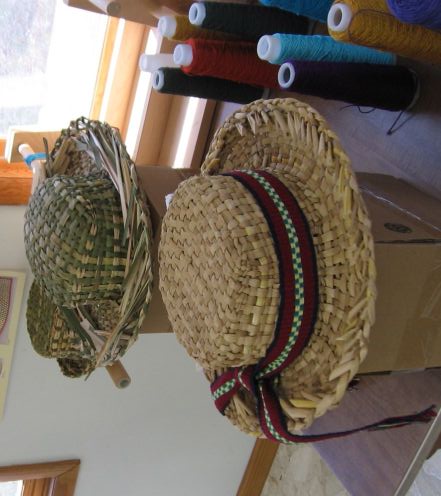

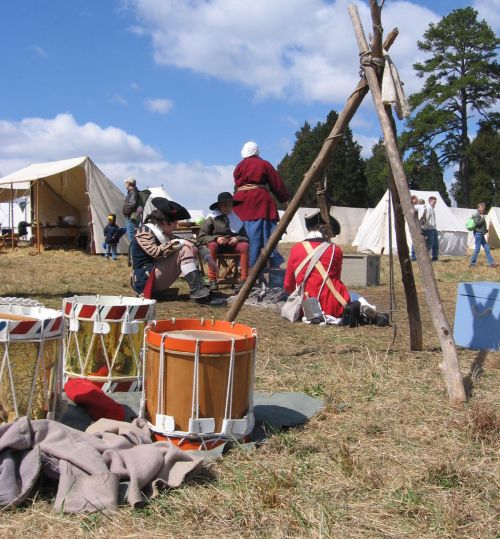
 Today’s reenactment of the Battle of Guilford Courthouse was chilly and muddy but at least the rain stopped. This reenactment is notorious for its bad weather (for around here, anyway). I had forgotten that the event was moved to Price Park last year, which is a little dodgy for taking photos without cars and electrical lines in the background.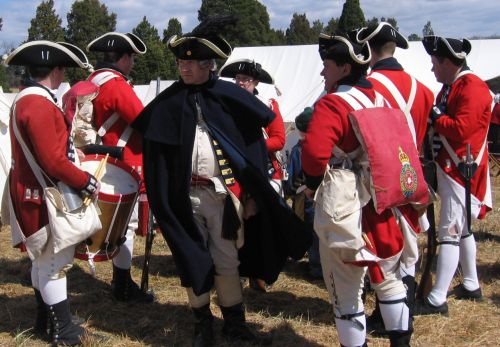





 slowly she turned