• Yesterday was a full day of mixed emotions. I mixed up three colors of Procion dyepots, then combined some to get a variety of colors on a variety of rags, fabric remnants, and silk and wool skeins. I didn’t get the purples that I wanted, so I’ll take that up at home. The dyepots were too red, but I was working with a turquoise dye and that color is difficult.

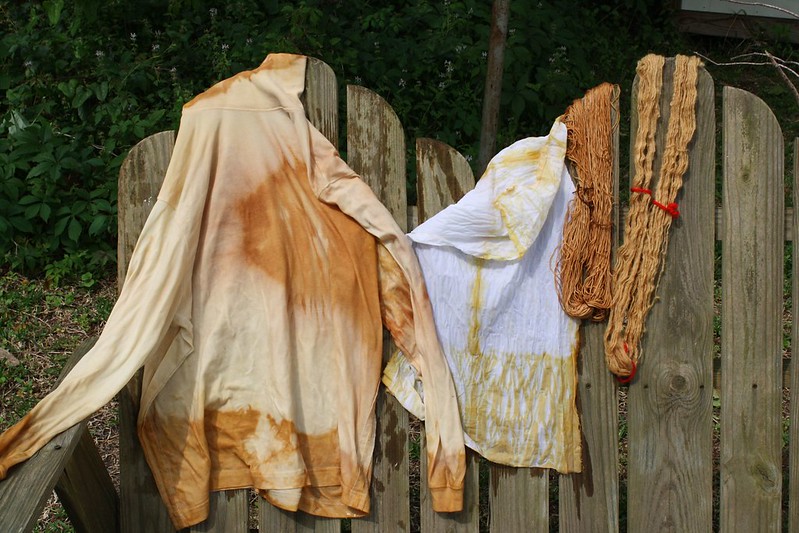
    I like the colors that I got on Sandy’s old khaki trousers and my old pajamas. These will go into the rag rug project. I haven’t decided about the fabric remnants. I’m thinking shibori and overdyeing on those.

    The wool skeins have very muted colors, which I expected (and wanted) because wool needs a hot dye bath. The silk skeins were fun and unpredictable. Lesson learned – do not use twist ties on skeins. What a mess to untangle.

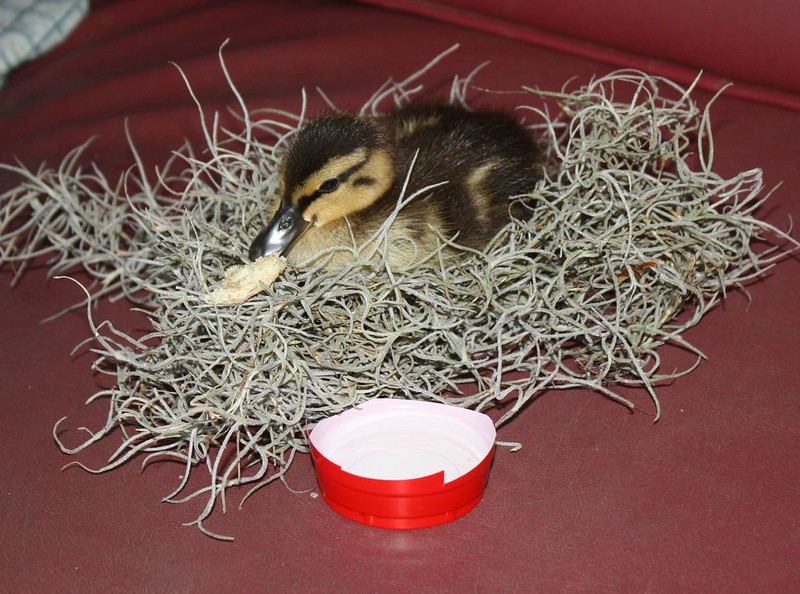
    The afternoon and evening became caught up in the small drama of trying to rescue an abandoned mallard duckling. Baby D was with a mama duck and three other ducklings at our house earlier in the day, but I noticed that Baby D kept her distance from the others. Mama Duck did check her out now and then but she swam away from the rest and Mama Duck abandoned her. We picked her up and she seemed exhausted and I really expected that she would die. We brought her/him onto the screened porch to protect her from predators and when the duck family did not appear again, we started researching wildlife rescue groups in the area. Skywatch Bird Rescue in Wilmington was willing to take her that night so we jumped in the car with Baby D (or Henry/Henrietta as Sandy named him/her) in a big box with a towel. As we were entering Wilmington she started freaking out and scrabbling around under the towel, pecking. She did that twice, and then she died just before we got there.

    I had already gotten attached and Sandy was sort of considering taking her home, which we both knew wouldn’t work. So sad. Her feathers were so soft and she relaxed when we petted her – it was obvious that she enjoyed it.

    So we drove back to the riverfront and had a pint of Smithwick’s at Slainte Irish Pub on Front St., then walked across the street to Circa 1922, where the food and service was amazing. Sandy had on shorts and flip flops and I know that I probably reeked from sweating over dyepots outside all day, and nobody seemed to notice or care. I had scallops over carrot spaetzle with pea sprouts and Sandy had chicken orechhiette with a cream sauce – both dishes were incredibly delicious, and the restaurant itself was full of huge reproductions of Hopper paintings on old brick walls. A fascinating ambience. I want to go back there because there was so much to choose from on the menu. They use local foods too. The carrots were obviously not from a store.

    I didn’t bring my camera or there would definitely be some food porn here.

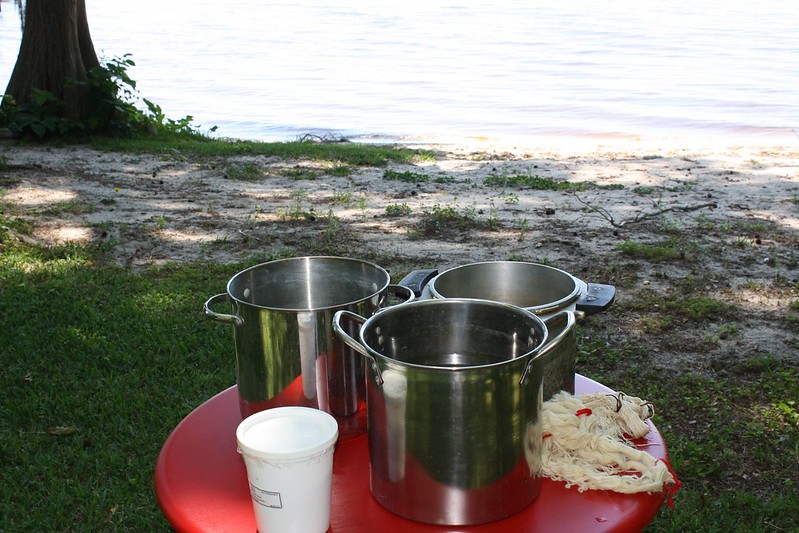
  • Yesterday was a day of experimentation with natural dyes with just the tannin-laced water of Lake Waccamaw as a mordant. The onion skin dye was very successful, although it is very hard to mess up yellow onion skins for a dye. What I did notice was that the color yielded more reddish tones, which I assume came from the tannin.

    I had a bamboo turtleneck sweater that had picked up a brown stain somewhere so that gave me a perfect opportunity to try dyeing bamboo for the first time. And boy, did it suck up the color! All I did was soak it in the lake water for a day and then dip dyed it in a cooling pot of onion skin dye. I’m really pleased with this.

    I was able to dye silk, wool, cotton, and bamboo in the same dyepot. I boiled the onion skins for a few hours and added everything after I took the pot off the heat and let it cool to below the simmering point. I heated up the wool skein gradually under hot water from the tap before I added it – it didn’t felt too badly.

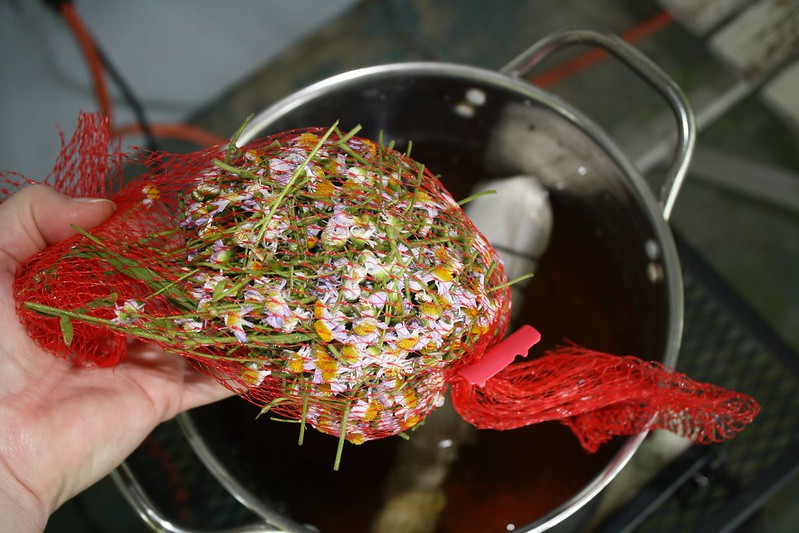
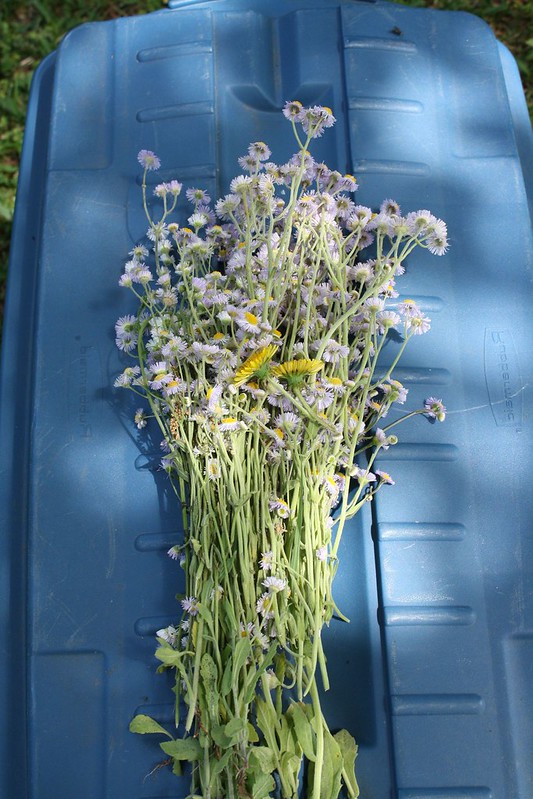
    The other dyepot was more problematic, and the way I dealt with it was not the best because I did get a little color out of it but I don’t know what factor produced it. I started with boiling English ivy leaves that I cut up in lake water. The water did turn a faint green, but when I dipped a wool skein in it it didn’t seem to pick up any color. So I added wild aster flowers that I picked from this yard and a yard down the road, with a couple of dandelion flowers thrown in just because they were there.

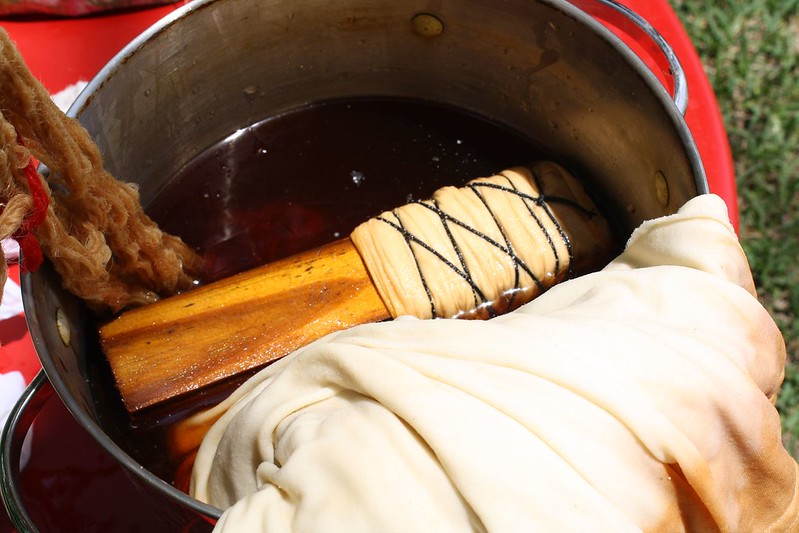
    The bundle is cotton wrapped around a thick twisted wire that I found and a bald cypress branch. I only added a silk skein because I didn’t think there would be enough dye produced to do any more.

    I got a very, very pale gray green on the silk, and a light yellow green on the cotton bundle. The color is stronger on the areas where the cypress branch was touching the fabric. So, did the cypress have some dye in it, or was it that the extra tannin drew in the dye that was there? I’m guessing that it was the tannin. So I’m going to try the English ivy dye again at home with a better mordant. I know that wild aster flowers produce dye because that was the first natural dye I ever produced on wool (with a mordant), but I suspect that I did not use enough flowers.

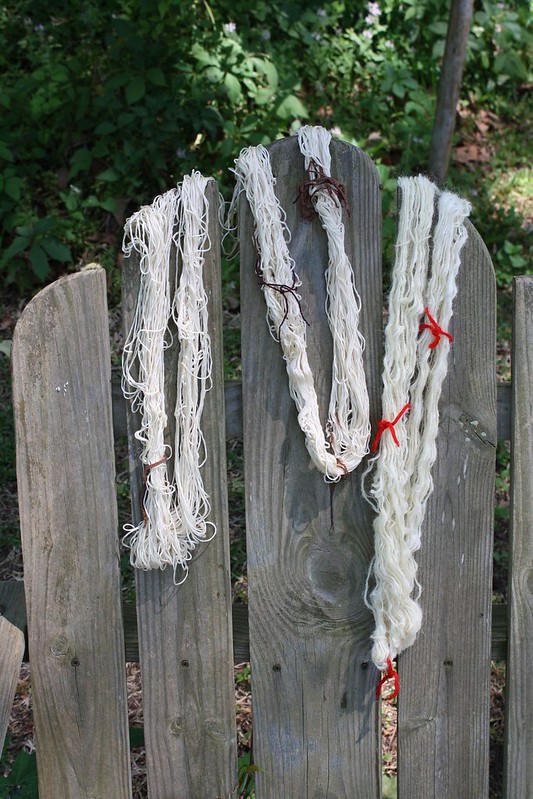
    The photo below is the silk skeins: English ivy/wild aster on left, no dye in the middle (for comparison), and onion skin on the right.

    The cotton fabric bundle being unrolled. The black is from the metal:

    You win some, you lose some. I still learned a lot from this. The pale color on the silk is very pretty.

    Last night I boiled Spanish moss and the lichens are still soaking. I’ll probably give them a shot today but my focus is turning to Procion dyeing and paste papers now. Hopefully some sun printing too, since the sun is back out.

    UPDATE: The green on the cotton bundle turned brown after washing. Much of the color on the cotton fabrics washed out. This could be due to a number of things, including commercial finishes. So I won’t be taking on another big dyeing project without using mordants (safe ones, of course). The onionskin dye still produced well on the bamboo sweater and the yarn skeins, though.

    Also, I learned in my natural dye workshop on June 1 that the “wild asters” were actually daisy fleabane, and you use the whole plant. The wild asters bloom in fall. Both are good sources of yellow dye.

  • I am back in one of my happy places – my cousin’s house at Lake Waccamaw. This time we are here alone for a couple’s art retreat. Sandy brought canvases and paint, and I brought dyepots, fabrics, yarns, hot plate, Procion dyes, and acrylic paints, paper, brayers, collage materials, and my Gelli plate. Also a tapestry on a box project I found in my closet that I had forgotten in case I get the urge to do some needle weaving.

    This time I’m taking the opportunity to concentrate on natural dyeing with the tannin-infused water of Lake Waccamaw to mordant my fibers. Hopefully, if I will maintain a wifi connection and the camera cooperates, I’ll document it here. This morning I am getting started by washing the silk and wool that I wound into skeins for dyeing with Ecover delicate wash detergent. I bought this silk on the cone from Colourmart and this is the first time that I have worked with it. It has to be scoured before dyeing. I bought the handspun wool from a vendor at the Greensboro Farmers’ Curb Market. I don’t remember the name of the farm and will add it later when I get home. The rest will be fabric remnants and scraps from my stash.

    Also on tap: sunprinting and gelli plate printing on fabric and paper. And photos. Stay tuned.

    And lots of reading in between. No cooking but I can’t avoid some cleaning. It is my cousin’s house, and it is May, and that means lots of bugs that have overwintered and lots of pollen on the porch. But, BEAUTIFUL weather – can’t ask for better. Sunshine, high 80s, lots of wind from the southwest.

    Yeah, it’s 4:42 now and I haven’t gotten much done. It’s mainly a set up and clean day. I tried to mix some Elmer’s Art Paste to paint paste papers with, but most of it is floating on the top of the pitcher in lumps. Most of the fibers need to soak anyway. Maybe I’ll just read for a while and tackle more tomorrow.

  • Just realized that I never published the update from a couple of weeks ago, duh. So it’s a two-fer today. Except this one will have pictures.

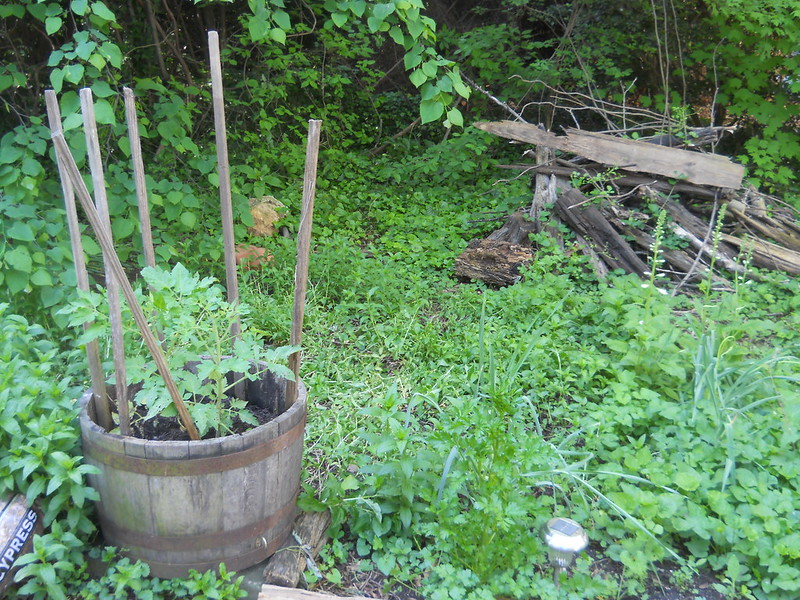
    I spent a lovely breezy morning in the Back Forty, and pretty much finished planting the rest of the garden. Even though I pronounced that I was going to be weaving and preparing warps and such yesterday, the forecasted rain did not appear until after dark. When you have a garden, especially one as mosquito-ridden as mine, you have to work it when it needs to be worked. I didn’t really mind, although sometimes it would be nice to split in two and be able to do both at the same time.

    That’s my neighbor’s hayfield to the left. Just kidding. Nobody has bothered to do anything to the yard for months after spending beaucoup bucks on landscaping. Puzzling behavior.

    Planted along the side fence: Violet’s Multicolored butterbeans and Kentucky Wonder green beans from Southern Exposure Seed Exchange. I’m delighted that Deep Roots Market is now carrying a good selection of their seeds. I also bought a few seedlings from them: Genovese basil, Zephyr squash, Straight Eight cucumbers.

    Most of my plants came from Handance Farm and Weatherhand Farm at the Greensboro Farmers’ Curb Market. I added a couple of German Johnsons and a Persimmon because Sandy was worried that we didn’t have enough slicing tomatoes. A valid point, since we tend to lose a lot to critters and some of these wonderful old heirlooms are bred for taste, not heavy production. As usual, I have lots of volunteer tomatoes which are probably Juliets. I crossed my fingers and planted yellow crookneck and zucchini squashes a couple of weeks ago, and so far they are doing well. Cucumbers and squashes do not grow well for me in this place.

    This morning I planted okra and purple hull and whippoorwill field peas, more carrots, lettuce (in a shady spot) and a bunch of old seeds that I pretty much decided to plant instead of throw out. Many years I have cast them out into the back and some would come up wherever they landed. This year the garden is still about a third overgrown so I found little spots here and there to plant them. Some I don’t know what they are, but I suspect they are either gourds or winter squash of some kind. So I may or may not have trombincino squash, radishes, canteloupes, etc. this year.


    The Back Forty is SO much different after twelve years of developing the soil and following permaculture principles! I used to hit thick red clay a few inches down. (This is still true in the front.) I was reminded of this when I planted a raised bed that had been left alone under a rock pile for a couple of years and thousands of ants had settled in. The soil on top is redder in that area from them bringing up the soil from beneath. This is excellent because clay does have many nutrients that can’t usually be used because it is so heavy and thick. Now this area that used to be all grass and violets is rich in earthworms and black soil.

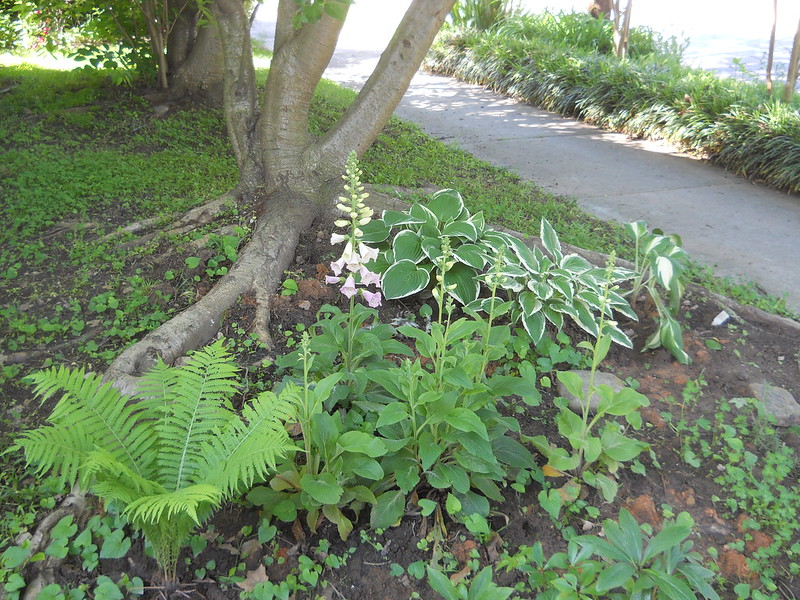
    I’m moving rocks and flowers and shade-tolerant plants to the front yard this year. So far I am very pleased with it, especially since it hasn’t cost me a penny.


    Lenten roses, foxgloves, ferns, hosta, yarrow, four o’clocks, parsley, oregano, thyme, rosemary. And some of those cute little blue star flowers that I love, but they aren’t blooming now. Solomon’s seal, bloodroot, my fading azaleas, and more ferns nearer the door, and violas, oregano, a rescued palm plant up on the…the…what do you call that thing? A wall. Seems like there oughta be a special name for it.

    And just so you don’t think it all looks this pretty:


    Eek!

  • I’m trying to get back in the habit of journaling or blogging. I’ve been feeling rather flat and it is good for me to write. I find it easy to write but hard to dedicate the time to it when there are so many projects calling to me during the little spare time I have in the spring. So I’m writing this post in bits and pieces as I snag a few minutes during lunch and the mood hits me right.

    I’ve spent most of that time in the yard the past few weeks. Sandy and I ripped out most of the vinca and other vines next to the fence. We mulched about half of the paths with cardboard and cypress mulch, and I’ve planted tomatoes, peppers, and leeks in six of the eight half whiskey barrels that used to be our rain barrels. I gave up on these rain barrels because 1) although picturesque and rustic, they were beginning to rot, 2) they were clogging up and breeding mosquitoes, and 3)I discovered that when we were in drought I never had any water stored in them anyway. A lot still needs to be done and I hope that I’ll get more done before the mosquitoes hatch out.

    Sunday, I dug up all the leeks in the bed next to the fence, because I’m going to plant my butterbeans there this year. The babies were planted into a barrel for next year’s harvest, and the others were cooked in chicken broth. Some I froze as base for soup, and some I baked in the oven with sliced fennel. I tossed them with a little melted butter and olive oil, poured a little of the broth over them, and sprinkled lemon pepper and fresh parmigiano cheese on top. Oh my God, so good. I planted fennel (a bulbing variety) this year and I hope it is a success since this vegetable is very pricey in the grocery store.

    I found a local supplier of loom reeds and he is making me two stainless steel reeds for my Macomber loom at a little more than half the price I can get them elsewhere. Plus I can pick them up and avoid shipping charges! I’m really happy about this, because I am still trying to save money for the India Flint workshop trip. It is due sometime within the next several weeks. I am going to consummate my marriage to this loom by a complicated double weave rag rug project based on the instructions in a book called Weaving Contemporary Rag Rugs that I’ve want to try for years, but I didn’t have a loom that was heavy duty enough to weave a good rug.

    My day has been made! I just heard that the Rhino Times is going out of business, and is in tons and tons of debt. I hate this publication with intensity. It is difficult for me not to curse like the worst sailor you have ever heard when I talk about them. I realize that the hole will be filled by another hatemongering group sooner or later, but hopefully the next one won’t target my friends personally.

    The end of the spring semester grows near, and sweet summer months with little stress and activity beckon. I’m going to kick it off with a trip to Lake Waccamaw the week after graduation. Sandy and I are going to make it an art retreat for the two of us.

  • After a trip to the Greensboro Farmers Curb Market and Lowe’s, our garden is finally starting to look a little better. Still a huge amount of work to do, but the four of the half whiskey barrels are filled with soil and I planted Brandywine, Cherokee Purple, San Marzano and Roma tomato plants from Handance Farm, and one barrel is devoted to hot peppers from Weatherhand Farm: Habenero (for Chuck and Leslie), Jalapeno, Hot Banana, Poblano, and Thai Hot. The Sweet Banana went into a pot by itself. The sweet peas are starting to come up. I still have squash, zucchini, fennel, and thyme plants to put in. Considering a rock garden along the sidewalk. I guess I’ll get around to planting my butterbeans and field peas this week or next.

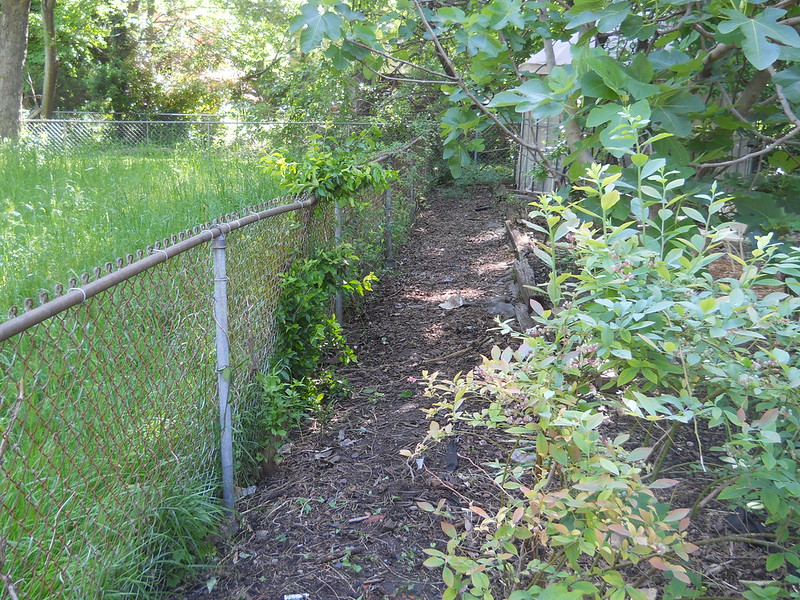
    Playing catch-up from three years of neglect is not easy. I have been concentrating on ripping out the vinca and English ivy and honeysuckle from the north side. Now that the next-door neighbor’s family stripped that yard and dug out the mess on her side of the fence, I need to jump on the chance of putting an end of the roots on my side. There’s a lot. Fortunately, I can also go around to the other side of the fence and pull out what is coming back over there. The chain link fence is ugly, but it will make a good support to grow some veggies along there. Now that the mulberry tree is gone, it is probably the sunniest place in the yard.

    I don’t know what the plan is for that house. It’s nice to have no one living there. Especially nice not to have someone who battles Satan loudly living there. I can relax in my yard and I love it. The fact that they haven’t cleaned out the inside and only come by to pick up the mail once a week is making me a little nervous. I told Sandy that maybe we should consider putting up a wooden privacy fence (lashing the panels to the existing fence) in case Chris moves back. Before she moves back, so she’ll be less offended. But, we need to make our first priority the bathroom, before one of us sits down on the toilet and ends up in the crawlspace.

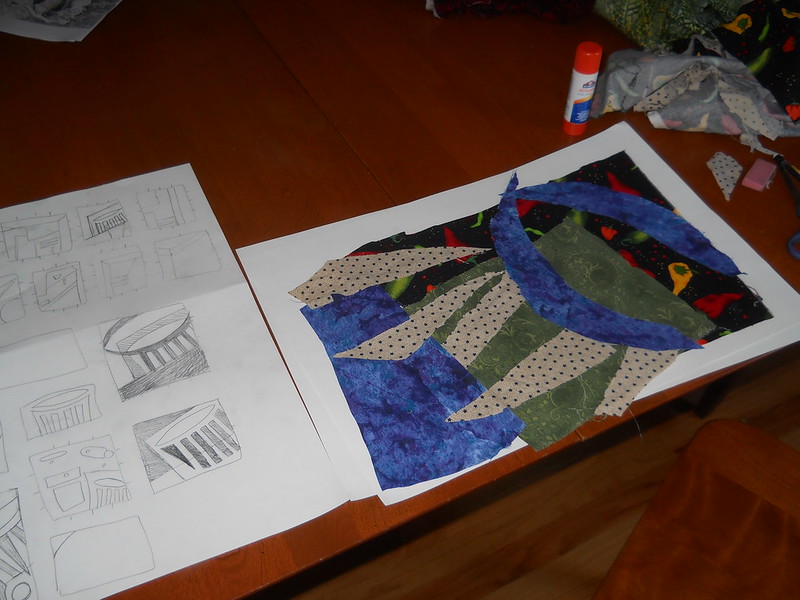
  • Last week I had the privilege of taking a small workshop with Lyric Kinard at her house in Cary, North Carolina. “Abstract-a-licious” was a inner-child embracing, extremely helpful class about designing for abstract art quilts, but the exercises that she introduced us to could be easily adapted to any kind of abstract art. Lyric went over the basic building blocks of good design and guided us through designing on paper and with cloth, scissors, and glue sticks. She served us a delicious lunch with warm, freshly baked bread and then each of us made a small abstract quilt top with fusible webbing, using our previous exercises as inspiration.

    If you get a chance to take a class with Lyric, I highly recommend it. It was fun and you leave with the ability to continue on your own.

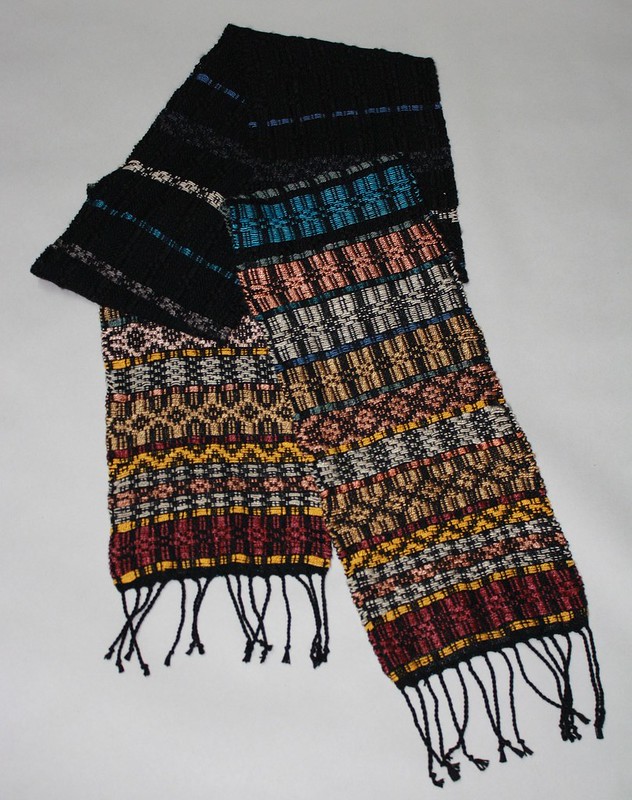
  • I managed to weave this six foot long overshot scarf during the month of February. The warp is thin cotton and the weft is silk, with lots of colors from different dyepots I’ve played with over the years, as well as some commercially dyed yarns from Treenway Silks. Some of the silk is from an order that our guild placed with a group helping a Colombian mountain community set up a silk industry back in the 1990s. That silk is handspun, and I just have a little bit of it left. I usually use it in tapestry because I like the textures that the unevenness of the handspun gives. I started with a overshot pattern that was published by Interweave Press, then, because I just can’t follow a recipe, I decided to take the theme of sunset turning into night, then sunrise. I’m going to do another one that will be similar.


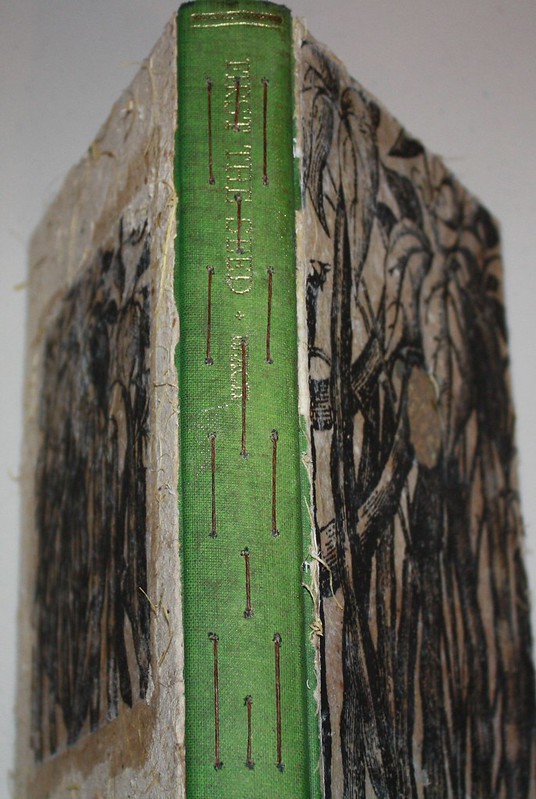
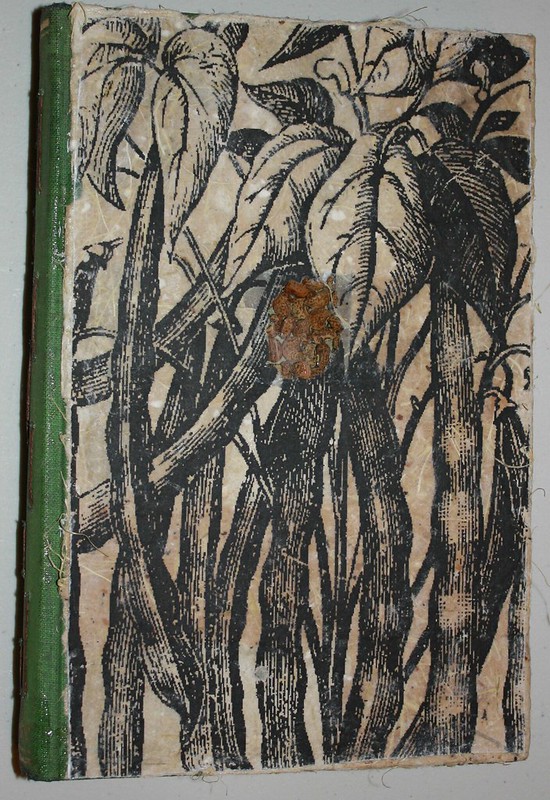
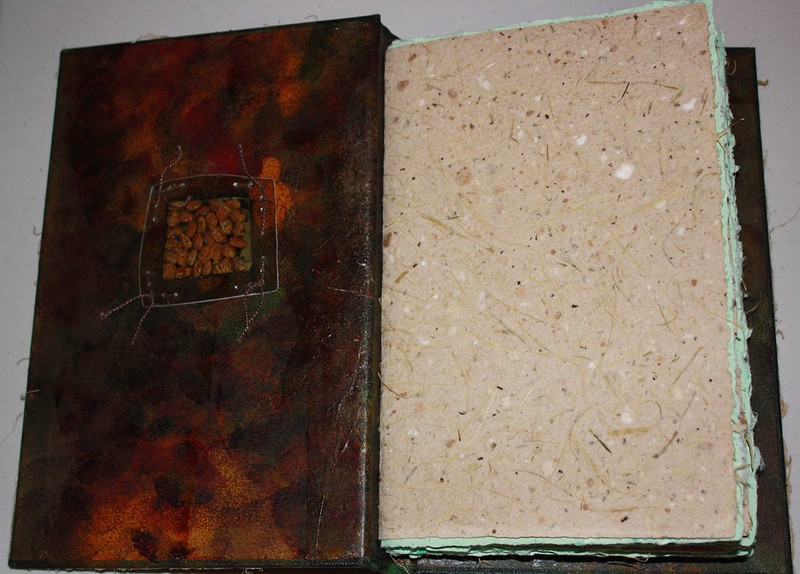
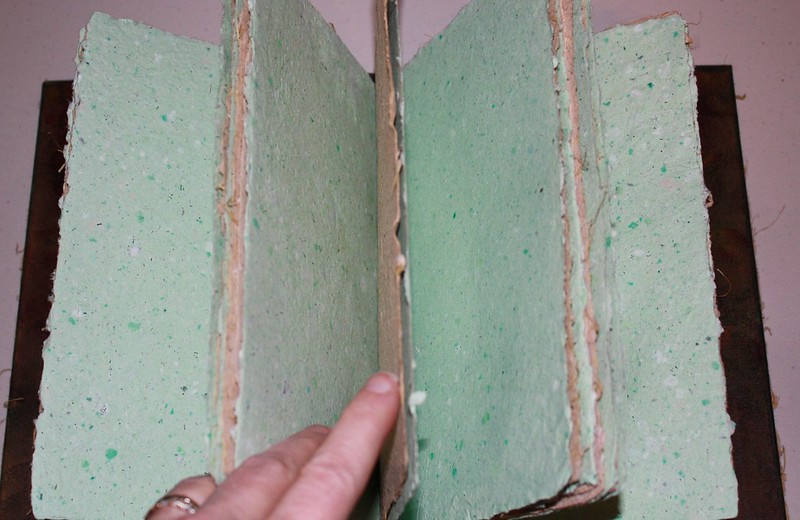
    This upcycled book really took a long time, but once I latched on to the idea of using field peas and an illustration from a seed catalog and handmade paper, it all came together. I scanned the illustration, printed it on a laser printer, and transferred it with gel medium onto handmade paper. The pages are handmade paper, some abaca/corn husks/whatever and some cotton/recycled office paper. I painted the inside covers with acrylic paint, enclosed the field pea “seeds” with mica windows, and bound it with a longstitch binding. The field peas are “Whippoorwill,” an heirloom variety that I first bought on a trip to Monticello and have been saving from year to year.

    a>

    Now I’m going to weave off the rest of this warp on the Baby Wolf and get ready to bring my adopted child Macomber loom home.

  • I blew right past blogging about my 52nd birthday and my 8th blogiversary. This will be a long post, I can see. Fortunately I have plenty of coffee and I’m not planning to go anywhere this morning.

    ***

    So, first I guess I’ll get caught up on the art retreat plans for the year, my true obsession. I did not get into Paper Book Intensive, which sort of threw me for a loop. I wasn’t upset, just a little surprised. Miss Laurie has gotten used to getting what she goes after over the years. This reality check is probably a good thing. I haven’t really been rejected for anything since I was job hunting ten years ago. Judy had informed me the day before that she was not able to attend, so I wouldn’t have had that extra pleasure of seeing her for ten days anyway.

    That made it easier to concentrate on how to get to Madeline Island, Wisconsin, for India Flint’s workshop. I finally worked out a scheme to fly from Raleigh (about 1.5 hour away) to Minneapolis for $283 round trip. A friend who lives in between and likes to run super early in the morning at a nearby park will take me to the airport in Raleigh and probably pick me up – I haven’t worked that out yet. My sister lives in Chapel Hill about 1/2 hour away so I’m going to talk to her about it, however, she and her family are usually at Lake Waccamaw that time of year. Anyway, once I get to Minneapolis, I hop on a bus to Duluth for a 3 hour bus trip, round trip about $69. Then I take a cab to the airport and get on the shuttle that Madeline Island School of the Arts provides for $100 round trip for the 1.5 hour trip to Madeline Island. Whew. The nice thing is that I’ll see a part of the country I’ve never seen, if I don’t fall asleep or get carsick on the buses.

    The way back is reversed except that I can’t make it back to Minneapolis in time to get a flight out that night. So I’m staying overnight in a Sheraton on Friday night, and I’m going to try to visit the Minneapolis Center for Book Arts before my flight out on Saturday.

    How is THAT for a complicated plan? Yet, believe it or not, it is much cheaper than flying into Duluth because all the flights during the time frame I needed were so expensive. That is why I was stressing over the whole Madeline Island trip. However, it is now a done deal. The tickets are bought and they are non-refundable so I could stop obsessing over it. Will it be worth it? I absolutely believe that it will, and I’m looking forward to the adventure. The Apostle Islands National Lakeshore seems to be the kind of place that stirs my soul – beaches, cliffs, water and wind polished stone…

    ***

    I’m going to do something less ambitious travel-wise and drive to Cary, N.C. on March 13 to take this workshop with art quilter extraordinaire Lyric Kinard: Abstract-a-licious, then go to Topsail Beach for a few days with my friend Missy Foy. You will not see me trotting along beside Missy. I need this kind of break badly right now, and a few books and a little walking on the beach will be soothing. Maybe I’ll take either a sewing machine or one of my new-to-me table looms too.

    ***

    This time of year is my busiest at work. I work in the kind of job that most of what I need to do has to be done January through April. Then I coast through the summer with less pressing projects, and fall is just about right as far as workload. I love my job. Even when I bitch about it, I know how lucky I am to have it and that it suits my personality and abilities as well as anything I’ve ever done. Lately with the economy in a downturn and our state legislature so dominated by anti-education Tea Party conservatives, it is more stressful because we have to plan for all kinds of contingencies in case our budget is slashed to the bone. We already went through major budget cuts a couple of years ago, and this year I have no doubt that some people I know are going to be hurt by it because there is nothing unnecessary left to cut. My job is safe as long as our graduate program is strong. It is in my interest to keep it that way, not to mention that I really care about our students. We have a governor with a liberal arts degree talking about funding vocational education instead of the liberal arts. These clowns in Raleigh are the laughingstock of the nation right now. It is very sad, and I’m afraid that the gerrymandering of districts will make it very difficult to uproot them until they have done some very serious damage.

    ***

    I think that I’ll do another post about my latest artwork rather than bury it in this long post that nobody is going to read but me.

    ***

    Since nobody else is reading at this point, here comes the medical bitching. First of all, my hands are doing great. But the rest of me seems to be chock full of inflammation. I’ve had some kind of weird problem with my right knee for two months now that must be either bursitis or tendinitis. I have had it x-rayed and I went to my chiropractor when the pain changed from occasional sharp pain when I touch my knee to the floor or other surface to general aches and tenderness from my hip to my ankle. Even my left leg started to hurt so Dr. Lewis suggested that it might be my shoes, although he doubted it since they are Merrills and I’m not walking funny. Changing shoes has not helped the original problem, although rest has lessened the general aching. I tend to forget about the knee thing, then get on the floor or tap it lightly against something and wham! Knife in the leg. Then I put ice packs on it, and get all depressed. My left elbow, which I hurt nine years ago, flared up again. What the hell? I am taking a huge handful of supplements and naproxen every morning and procrastinating about going to an orthopedist.

    I joked (if you can call it that) to my weaving friends that I got rid of my table loom because my hands couldn’t deal with flipping the levers, and now that I have my floor loom up and running, my legs hurt when using the floor treadles. Maybe there is a lesson here.

    In any case, I do have lots of alternatives when it comes to different types of looms now.

  • Guess what I just did? I bought an old Macomber Add-a-Harness loom. Yes I did. Along with a couple of Leclerc Dorothy table looms, three tapestry frame looms, and a large spool rack last week. This also means that it is likely that I’ll have a Baby Wolf loom for sale soon. The Center for Visual Arts in Greensboro decided to close down their weaving program and sell off the looms and equipment dirt cheap. I think that it’s a real shame that they did this, since it was a unique offering for the area and could have been promoted and turned into something special, but local weavers and schools are benefiting from their loss. Photos later – I have a lot of show and tell but not a lot of time to post.

    Macomber looms

    Macomber Looms and Me